
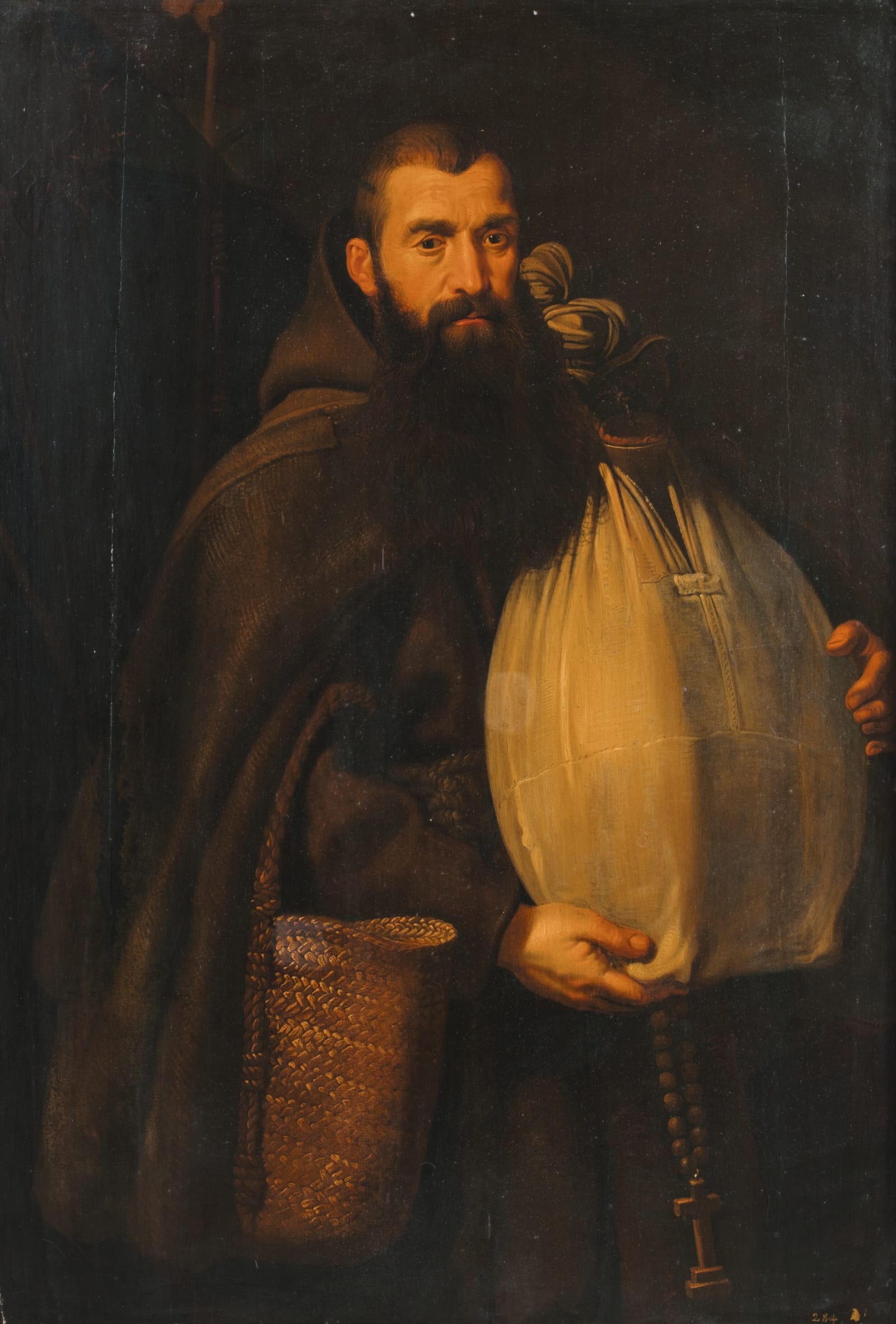
Felice Porri (Felix) was born to a Cantalice peasant family in the Sabine hills and worked as a shepherd through his childhood and as a tenant farmer through his twenties. After a near-fatal farming accident (an ox-cart ran over him without injury — an event he interpreted as a divine call), he sold his small holdings, distributed the proceeds, and walked to Rome to enter the Capuchin Franciscans (the new strict-observance branch founded in 1525). He was received as a lay brother in 1543 at the Capuchin convent of Anticoli (Lazio).
In 1547 he was sent to the Roman convent of San Bonaventura, where for the next forty years — until his death — he served as the daily questuant (alms-collector) of the community, walking the streets of Rome with a small bag over his shoulder, collecting bread for the friars and for the poor families they supported. His characteristic greeting on every street was 'Deo gratias!' ('Thanks be to God!') — the words said for everything received, including blows and insults. Roman children flocked to follow him; he taught them catechism by composing rhymed couplets to fit street songs popular at the time.
Charles Borromeo, Philip Neri, and Camillo de Lellis were his closest friends in Rome; Borromeo once told Pope Pius V that Brother Felix's daily street ministry was more valuable to Rome than the deliberations of three cardinals. Felix died at the Roman convent on May 18, 1587. He was canonized in 1712 — the first Capuchin formally canonized.