
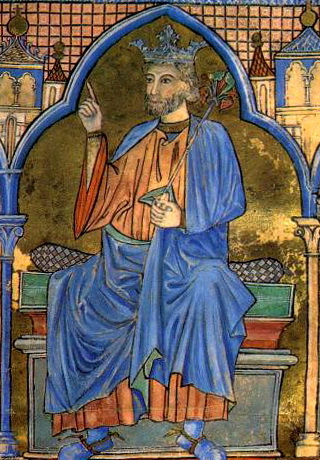
Ferdinand became King of Castile in 1217 (through his mother Berenguela) and of León in 1230 (on his father Alfonso IX's death), permanently uniting the two crowns. His thirty-five-year reign was dominated by the most successful single phase of the Reconquista: in 1236 he took Córdoba (recovering the great Mosque-Cathedral after five centuries of Islamic rule), in 1243 Murcia accepted his protectorate, in 1246 he took Jaén, and on November 23, 1248 — after a sixteen-month siege — he received the surrender of Seville. By his death only the small Nasrid emirate of Granada remained of al-Andalus.
His personal piety was austere: he attended Mass daily even on campaign, was a Tertiary of the new Franciscan Order, slept on the ground, and was famous for his refusal to celebrate triumphs after victories. He founded the University of Salamanca's first formal cathedra (1218), refounded the Cathedral of Burgos in Gothic style, and personally signed the bull authorizing the conversion of the great Mosque of Seville into the cathedral — though the present Cathedral of Seville was not built until the early fifteenth century.
He died at Seville in May 1252 — kneeling at his bedroom altar, in his Franciscan tertiary habit, having received the Last Sacraments. He was canonized by Clement X in 1671. His incorrupt body is preserved in a magnificent baroque silver coffin in the Royal Chapel of Seville Cathedral; the coffin is opened only three times a year (May 30, August 22, and November 23 — the anniversary of the surrender of Seville) for public veneration.