
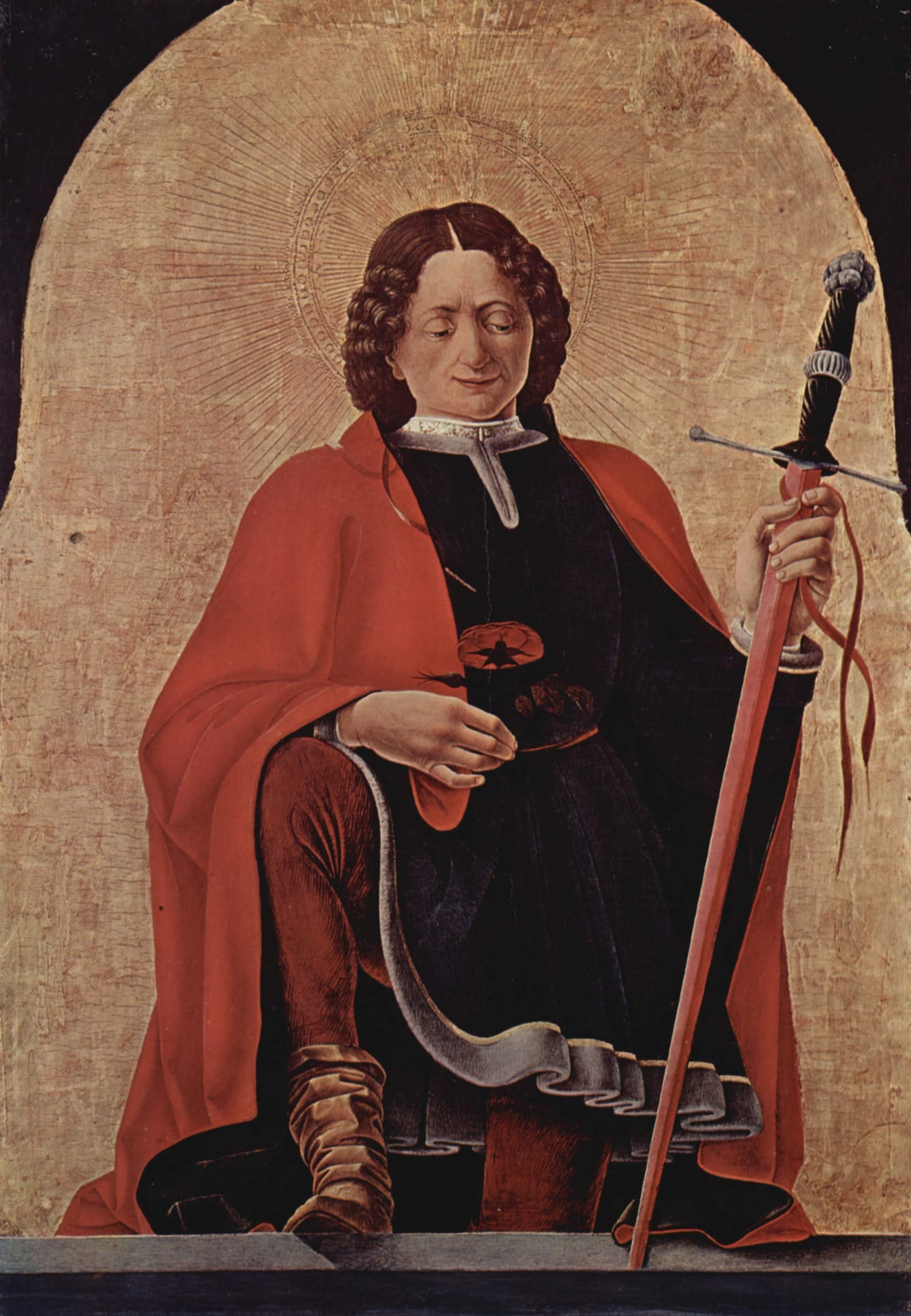
Florian (Latin Florianus, 'flowering') was a Roman army officer (princeps officii — the chief administrative officer of the Roman provincial governor's staff) of the Roman province of Noricum, born at Aelium Cetium (modern Sankt Pölten, the capital of the Austrian state of Lower Austria) and serving at the great Roman frontier camp of Lauriacum on the Enns River — a key Roman military station on the Danube limes.
When the Diocletianic edicts of 303 reached Noricum and the Roman governor Aquilinus began arresting the substantial Christian community of Lauriacum and its surrounding camps, Florian — a Christian himself, though the rank and position made his Christianity an open secret — refused to participate in the enforcement and openly intervened to support the arrested Christians. He was arrested on May 4, 304, by Aquilinus's order, tortured, and finally drowned in the Enns River with a millstone tied around his neck.
The body was recovered downstream by a pious local Christian widow named Valeria, who buried it secretly. The cult became extraordinarily widespread across the medieval Holy Roman Empire, particularly in southern Germany, Austria, Bohemia, Slovenia, and Poland. The great Augustinian Canons' monastery of Sankt Florian (founded over the original burial site, refounded by the great Augustinian abbot Engelmar in 1071, and rebuilt as the magnificent Baroque basilica by Jakob Prandtauer between 1686 and 1708) is the principal Austrian Catholic shrine outside Vienna. Anton Bruckner (the great Austrian Romantic-era composer) served as organist there for many years and is buried beneath the great Baroque organ.
Florian's universal modern patronage of firefighters derives from the foundational medieval iconographic association of him with the controlling of water (his death by drowning) — extended in the late medieval period to the controlling of fire by water. He is the universal patron saint of professional firefighters worldwide; the Florian's Day of May 4 is observed in fire departments across the world.