
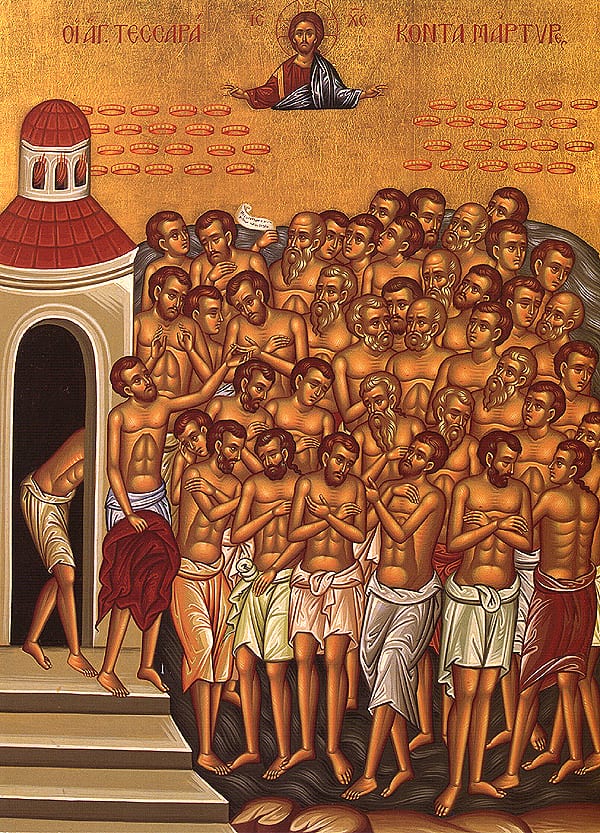
The Forty Martyrs of Sebaste were forty Christian soldiers of the Legio XII Fulminata (the Twelfth Legion 'Thundering,' the same legion to which the famous 'Thundering Legion miracle' of Marcus Aurelius's time had been attributed — see Apollinaris of Hierapolis in the 2nd-c. supplemental catalogue). The Legion had been stationed at Sebaste in Armenia Minor (modern Sivas in central Turkey) for over a century by the time of the Licinian persecution of 320 AD.
In the winter of 320, under the Emperor Licinius (who had broken with Constantine and was beginning a new local persecution in the eastern empire), the commander of the Sebaste garrison required all soldiers to perform the public pagan sacrifices. Forty of the Christian soldiers refused. The commander — wishing to break their resolve without permanently losing forty experienced legionaries — ordered them stripped naked and forced to stand all night on the frozen surface of a lake outside Sebaste, with a heated bath-house on the lake shore as the visible alternative for any who would recant.
One of the forty — overcome by the cold — broke and ran to the heated bath-house, dying immediately of cardiac shock from the temperature change. One of the Roman guards on the shore — who had observed the others' refusal to break — converted on the spot, stripped off his own clothes and ran out to take the place of the apostate, bringing the count back to forty. At dawn, the surviving thirty-nine (now including the convert guard) were finally killed by being clubbed on the legs and beheaded; one young soldier named Meliton who had not yet died was carried by his mother on her shoulders to the pyre with his companions, dying as she carried him.
The cult became extraordinarily widespread in both Eastern and Western Christian traditions. Basil of Caesarea (his cousin had been one of the Forty) preached the foundational homily on them in the late 4th century. Gregory of Nyssa preached another. The 5th-century church of the Forty Martyrs in Constantinople (now lost) was one of the great early-Byzantine pilgrimage churches; relics were translated throughout the Christian world.