
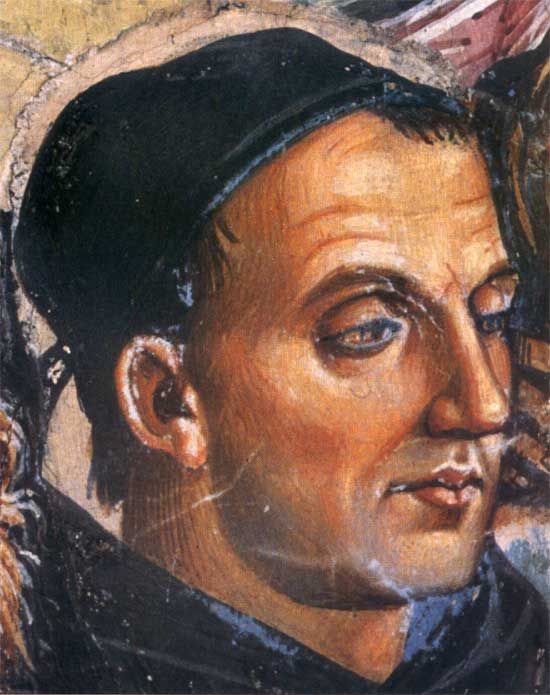
Guido di Pietro was born around 1395 at Vicchio in the Mugello region of Tuscany. He trained as a painter in the Florentine workshops of the late-Gothic tradition — under the influence of Lorenzo Monaco (late-Gothic-Byzantine painter) and the contemporary Masaccio (father of Renaissance painting).
Around 1420, Guido entered the Dominican Order at the Convent of San Domenico at Fiesole — the Dominican Observant Reform convent that had been established in the Fiesole hills above Florence. He received the religious name John of Fiesole (Fra Giovanni da Fiesole) — the epithet 'Angelico' ('Angelic') was applied to him by his contemporaries during his lifetime and became his famous popular name.
Fra Angelico combined the Dominican religious vocation with the painter's vocation — producing the most extensive corpus of Early Renaissance sacred art by any Dominican or any Catholic religious of the period.
His principal masterworks include:
1. The Fiesole Altarpiece (c. 1425) — the early Fiesole convent altarpiece.
2. The San Marco Convent Frescoes (Florence, 1438–1445) — the famous cycle of monastic-cell frescoes at the Dominican Convent of San Marco in Florence, executed under the patronage of Cosimo de' Medici. The San Marco cycle — one of the most extensive Early Renaissance fresco cycles — includes the famous 'Annunciation' (top of the stairs), the cell-frescoes (one for each Dominican cell, producing the meditative-liturgical iconographic programme), the Crucifixion in the Chapter House, and the Sacra Conversazione altarpiece.
3. The Chapel of Nicholas V (Rome, 1447–1449) — the famous frescoes at the private papal chapel of Pope Nicholas V in the Vatican Palace, the 'Lives of Sts. Stephen and Laurence' cycle.
4. The Orvieto Cathedral Chapel of San Brizio (1447) — the partial fresco-cycle at the famous chapel of San Brizio at Orvieto Cathedral (the chapel subsequently completed by Luca Signorelli in 1499–1502 with the famous Last Judgment fresco).
5. multiple altarpieces across Florence, Cortona, Perugia, and Rome.
Fra Angelico's artistic style — combining the late-Gothic sacred-devotional aesthetic with the Early Renaissance perspectival-anatomical innovations, producing the uniquely serene-luminous quality that distinguished him from his contemporary Masaccio and Renaissance painters — institutionally established the 'Fra-Angelico' style as the classical Catholic sacred-art tradition of the Renaissance.
Fra Angelico served as prior of San Domenico at Fiesole from 1450 to 1452. He died at Rome on February 18, 1455 while engaged in the final Roman commissions.
His beatification by Pope St. John Paul II on October 3, 1982 — and his declaration as 'patron of Catholic artists' by the same pope in 1984 — institutionally recognized the Catholic artistic-mystical vocation that Fra Angelico exemplified.