
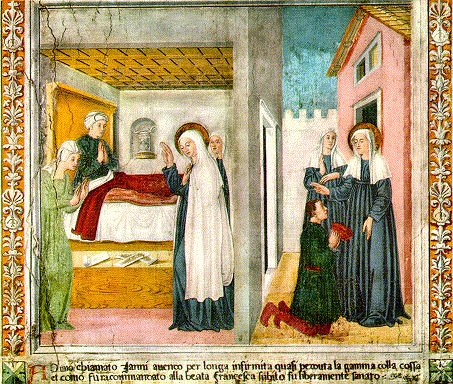
Francesca Bussa de' Leoni was born to the Roman nobility at the height of the Western Schism and the political collapse of the Papal States, when Rome itself was a chaotic and dangerous city. At twelve she was married against her wishes to Lorenzo Ponziano of the noble Ponziano family; the marriage lasted forty years and was, against all expectations, deeply happy. She bore him several children. She was a model of the lay Roman matron of her time: devoted to family, charitable in a city racked by plague and war (she lost two of her own children to plague), and exemplary in piety while living entirely in the world.
From around 1425 she gathered other married and widowed Roman noblewomen into a society called the Oblates of Mary, dedicated to good works without enclosure — visiting the sick, feeding the poor, teaching catechism, ransoming captives. After Lorenzo's death in 1436 she withdrew to the small monastery of Tor de' Specchi on the Capitoline Hill, where the Oblates lived in community without formal religious vows.
Throughout her adult life she reported being accompanied by a visible guardian angel — appearing as a child of about nine, in white and gold — who walked beside her, lit her way at night (the basis for Pius XI's 1925 declaration of her as patroness of motorists), and rebuked her when she failed in obedience. Her mystical experiences and visions of purgatory were extensively recorded by her confessor Giovanni Mattiotti. She died at Rome in March 1440. Pope Paul V canonized her in 1608. Her tomb is in the church of Santa Francesca Romana on the edge of the Roman Forum.