
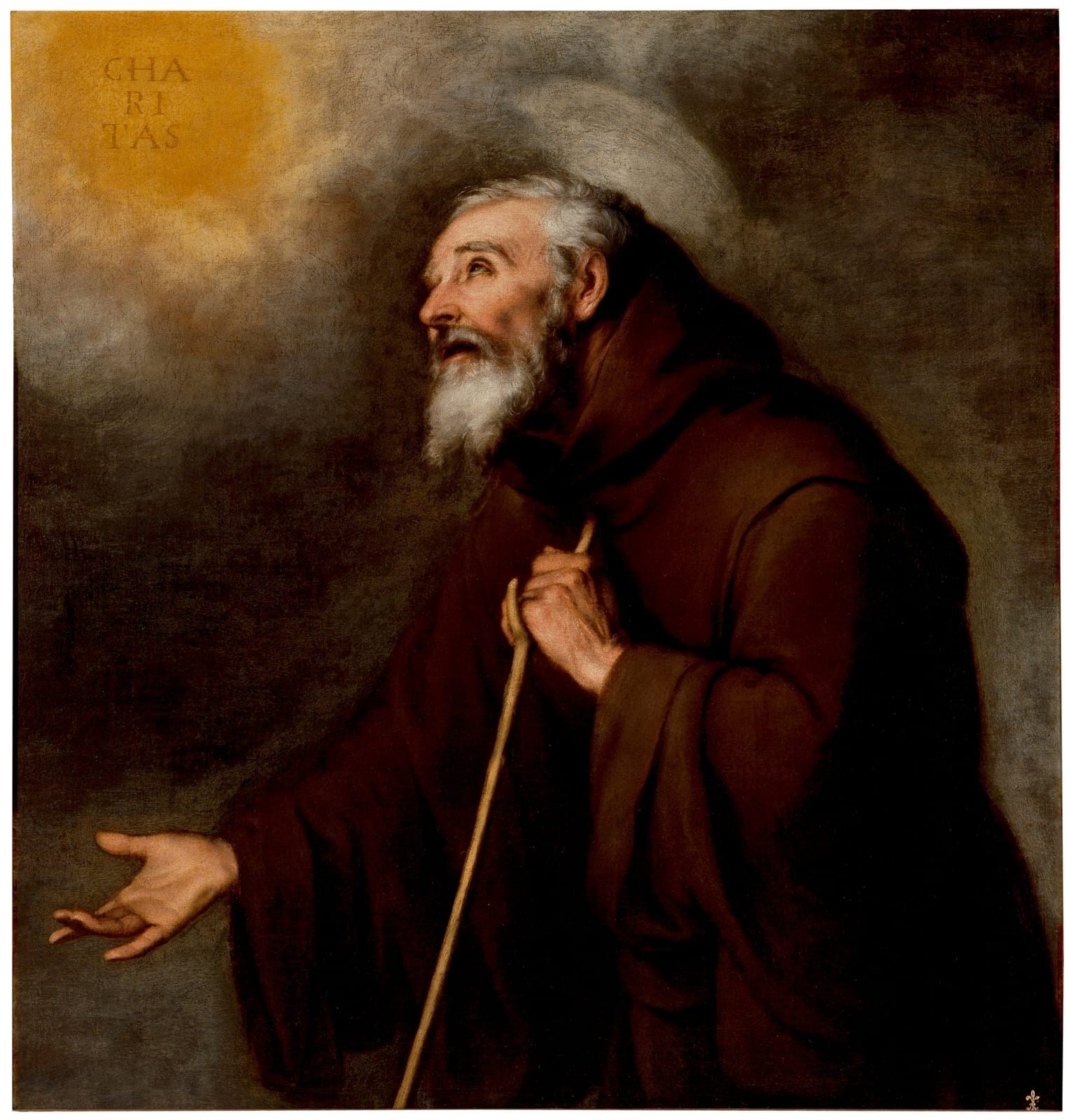
Francis went into a cave on the coast below Paola at about fifteen and lived there alone for six years. In 1435 two companions joined him, three cells and a chapel were built, and a religious order had begun without anyone quite deciding to found one. Sixtus IV approved it in 1474, and Alexander VI gave it the name Francis wanted: the Minims, the least of all religious. Their fourth vow is a perpetual Lenten fast, no meat, eggs or dairy, kept the whole year round.
He never left the south of Italy until he was nearly seventy, when Louis XI of France, dying at Plessis-lès-Tours and terrified of death, sent to Calabria for the hermit whose miracles he had heard of. Francis would not come until the pope ordered him to. He told the king to prepare to die, and stayed with him until he did, in August 1483; Charles VIII and Louis XII kept him in France for the rest of his life, and he died at Plessis on Good Friday, 2 April 1507, at ninety-one. Leo X canonised him twelve years later.
In 1562 the Huguenots broke open his tomb at Plessis, found the body incorrupt, and burned it; the bones that Catholics rescued from the fire were carried to churches in France and Italy, and the sanctuary at Paola, built over his first cells, keeps the chief of them. Seafarers took him for their own, on the strength of the story painted a hundred times of his crossing the Strait of Messina on his cloak.