
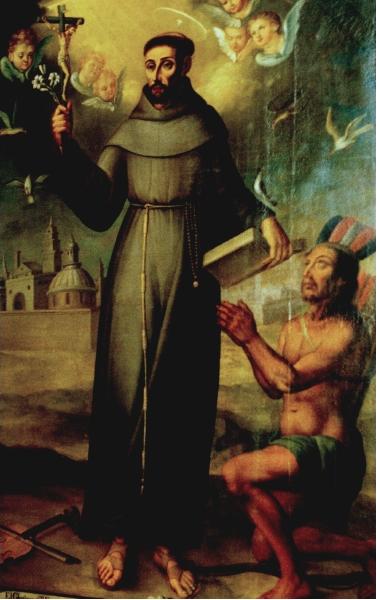
Francisco Sánchez Solano y Jiménez was born to the Andalusian gentry at Montilla and entered the Observant Franciscans at twenty in 1569. He was ordained priest in 1576 and served twenty years in the Andalusian convents and as plague-chaplain in the 1580s and 1590s. In 1589, then forty, he volunteered for the missions to South America.
He arrived at Lima in 1589 and was sent at once to the Río de la Plata region (modern Argentina, Paraguay, Bolivia) — the largest, most thinly-evangelized portion of the Spanish American empire. For twenty years (1589–1610) he travelled the vast distances between Tucumán, Salta, La Rioja, Córdoba, and Santiago del Estero in Argentina, Asunción in Paraguay, and Chuquisaca and Potosí in Bolivia. He learned the major indigenous languages of the region (Quechua, Tonocoté, Lule), composed catechisms in them, and is credited with the baptism of an estimated nine thousand indigenous Christians in a single mission visit to one Tucumán region. He was famous for travelling with a violin which he used to teach Christian prayers in song to indigenous communities.
He returned to Lima in 1604 as Guardian (superior) of the great Lima friary of San Francisco, where the young Martin de Porres was a Dominican novice across the city. He died at Lima on July 14, 1610. Canonized 1726, he is the principal patron saint of Argentina and the second-greatest Franciscan apostle of the Spanish New World after Junípero Serra (who would not be born for another century).