
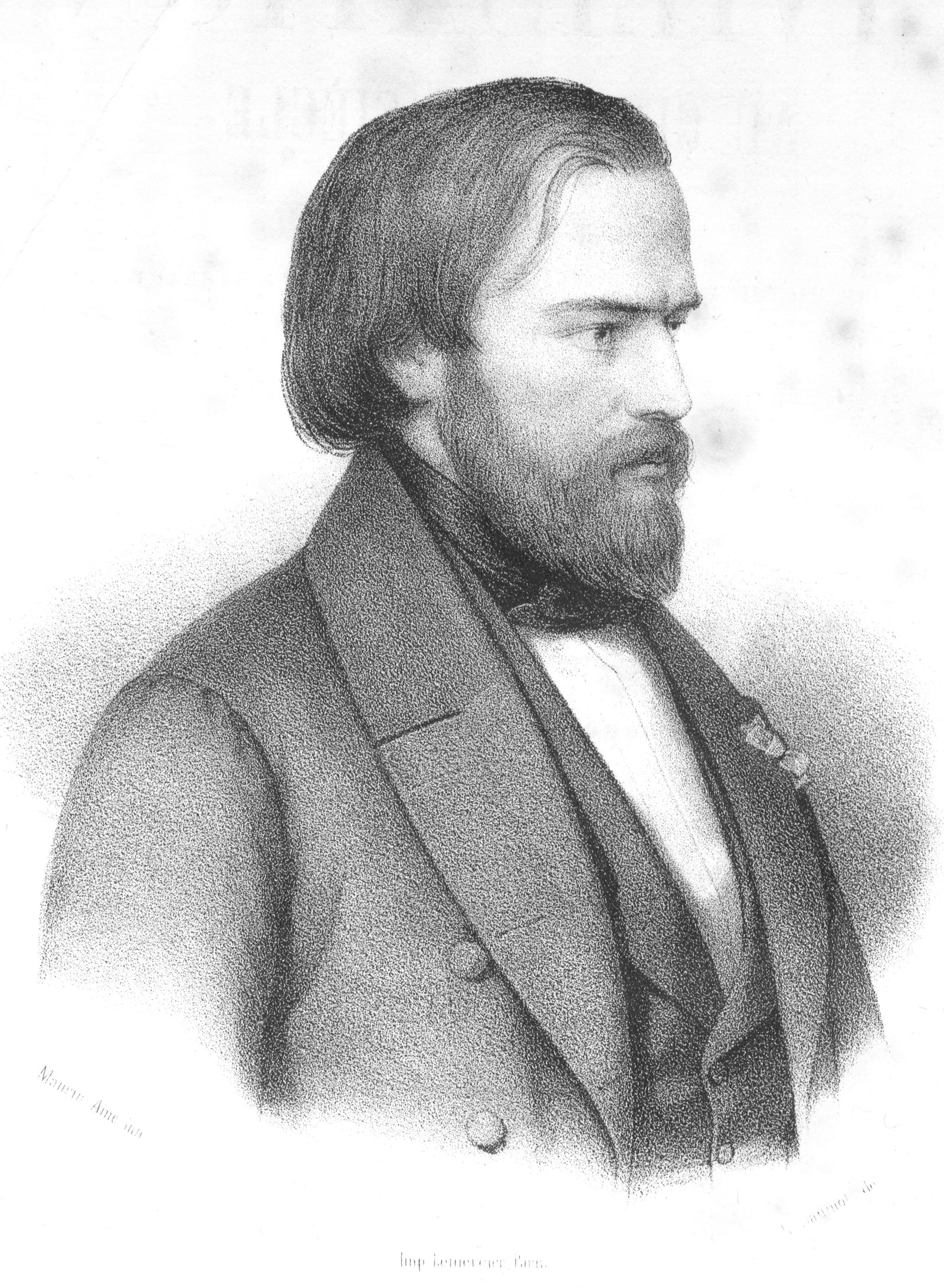
Antoine Frédéric Ozanam was the son of a French Catholic physician and academic working in Napoleonic Milan; the family returned to Lyon after Napoleon's fall. He was educated at the Royal College of Lyon and from 1831 at the Sorbonne in Paris — where he studied law (graduating Doctor of Laws 1836) and then literature (Doctor of Letters 1839), becoming professor of foreign literature at the Sorbonne in 1844 at thirty-one — the youngest Sorbonne professor of his generation.
On April 23, 1833 (his twentieth birthday) — at a small gathering of Catholic university students at the Paris flat of the historian Emmanuel Bailly — Ozanam and six fellow students founded the Conference of Charity (Conférence de Charité), a small lay Catholic society dedicated to the personal direct visitation of the poor of Paris. Their immediate model was the Daughters of Charity of Vincent de Paul (see Vincent de Paul's entry in the 17th-c. catalogue), and they chose Vincent as patron; the society was formally renamed the Society of Saint Vincent de Paul in 1834.
The Society spread rapidly across France and Europe through the 1840s and 1850s — by Ozanam's death in 1853 there were over 2,500 conferences in fifteen countries. By 2024 the Society of Saint Vincent de Paul has over 800,000 members across 153 countries and is the largest Catholic lay charitable network in the world. Its specific charism — personal direct face-to-face encounter of lay Catholics with the poor through systematic regular home visits, distinct from institutional Catholic charity — was Ozanam's principal contribution to modern Catholic social practice.
He combined this active social work with major scholarly and political contributions: his works on the Christian origins of European medieval civilization (Civilization in the Fifth Century, 1855), his political engagement during the 1848 Revolution (he was a key Catholic supporter of moderate political republicanism and edited the journal L'Ère Nouvelle), and his sustained correspondence with the contemporary Catholic intellectual movement around Lacordaire, Montalembert, and Lamennais. He died at Marseille on September 8, 1853 at forty, of tuberculosis. Beatified by John Paul II in 1997.