
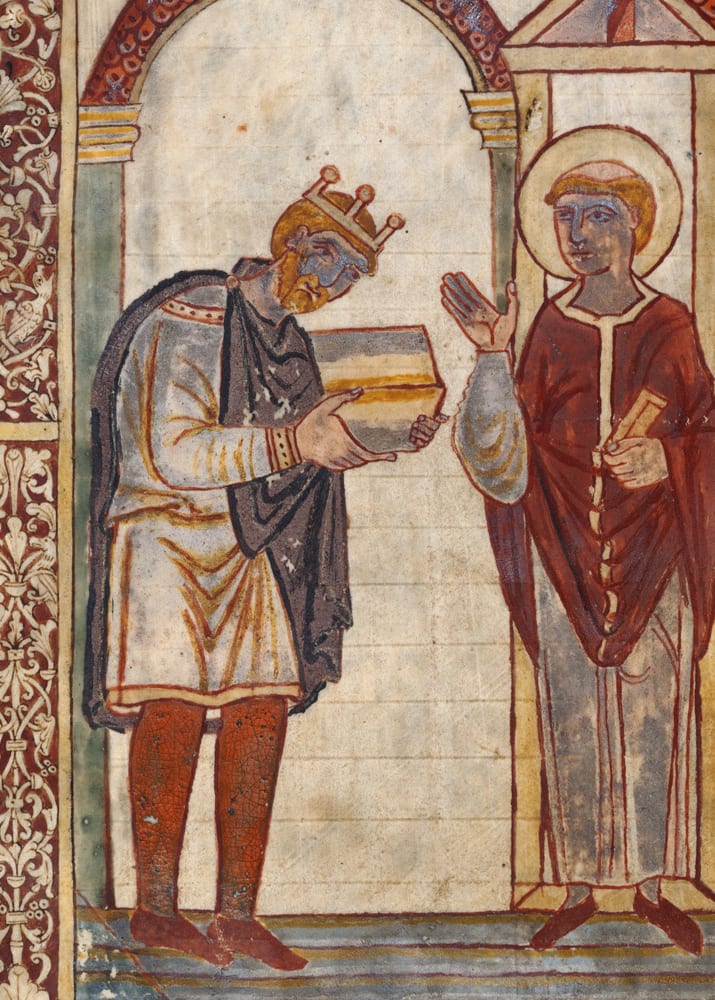
Frithestan was consecrated Bishop of Winchester on June 9, 909 by Archbishop St. Plegmund of Canterbury — as part of the Plegmund 909 reorganization of the Wessex diocesan structure (the creation of the five new Wessex dioceses to replace the over-large existing two).
For 22 years (909–931) he served as Bishop of Winchester — the principal Wessex see, the royal capital of King Edward the Elder and the early reign of King Æthelstan.
He is most renowned for the Frithestan Stole — the magnificent Anglo-Saxon embroidered stole (with matching maniple) commissioned for him as episcopal vestments around 909–916 by Queen Ælfflæd (the second wife of Edward the Elder, the stepmother of Æthelstan), and preserved through the centuries as the principal surviving example of pre-Conquest English ecclesiastical embroidery.
The Frithestan Stole was given (after Frithestan's death) by King Æthelstan to the shrine of St. Cuthbert at Chester-le-Street as a royal-pilgrim offering around 934 — and was re-discovered in 1827 when the tomb of St. Cuthbert at Durham Cathedral was opened during the excavation of the saint's relics. The Frithestan Stole and Maniple survive today at the Durham Cathedral Library — the principal surviving example of pre-Conquest English ecclesiastical embroidery and one of the greatest treasures of Anglo-Saxon Catholic material culture.
Frithestan resigned the Winchester see in 931 due to age and infirmity, and died at Winchester on September 10, 932.