
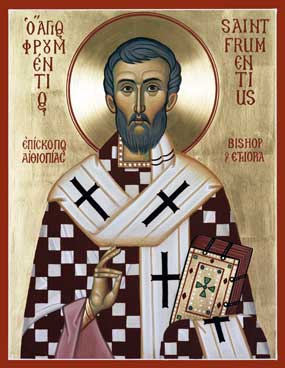
Frumentius (Latin Frumentius, Ge'ez Fremenatos, Ethiopian Abba Salama 'Father of Peace') was — per the foundational 4th-century account preserved by Rufinus of Aquileia, who knew Frumentius personally and questioned him directly — a young Christian of Tyre. As a teenager he and his brother Edesius were taken on a Red Sea trading voyage by their uncle, the Tyrian Christian philosopher Meropius. The ship — caught in a storm — put in at an Ethiopian Red Sea port and was attacked by local raiders; the entire crew except the two boys was killed.
The two surviving brothers were taken to Aksum (the capital of the Kingdom of Aksum, the great Christian-era Ethiopian polity) and presented to the Ethiopian Aksumite King Ella Amida. The king made Frumentius his royal secretary and Edesius his cup-bearer. Frumentius — in his administrative role at the Aksumite court over the next two decades — quietly built up a small Christian community among the Aksumite court of foreign traders (Frumentius brought from Egypt the Christian priests and books needed to sustain the community).
When the king died, Frumentius and Edesius were given their freedom by the queen-regent. Edesius returned to Tyre. Frumentius travelled to Alexandria and presented himself to the Patriarch Athanasius (see Athanasius's entry already in the catalogue) around 340 AD, asking that a bishop be consecrated for the new Ethiopian-Aksumite Christian community. Athanasius — recognizing Frumentius himself as uniquely qualified — consecrated him bishop and sent him back to Aksum as the first Patriarch of Ethiopia.
Frumentius's pastoral work over the next four decades established the foundational Ethiopian Christian Church. He converted the new young King Ezana (who succeeded his father) and Ezana's brother Saizana to Christianity around 340–350 AD; the conversion is independently attested by Aksumite numismatics (the Aksumite gold coins of Ezana — the foundational documents of African Christian history — change from pagan symbols to the cross around exactly this date). Through Frumentius, Ethiopia became the second nation in world history (after Armenia in 301) to formally adopt Christianity as the official state religion. The Ethiopian Orthodox Tewahedo Church traces its foundational succession directly to Frumentius. He is universally venerated in the Ethiopian Christian tradition as Abba Salama Kasate Berhan — 'Father Peace, Revealer of the Light.'