
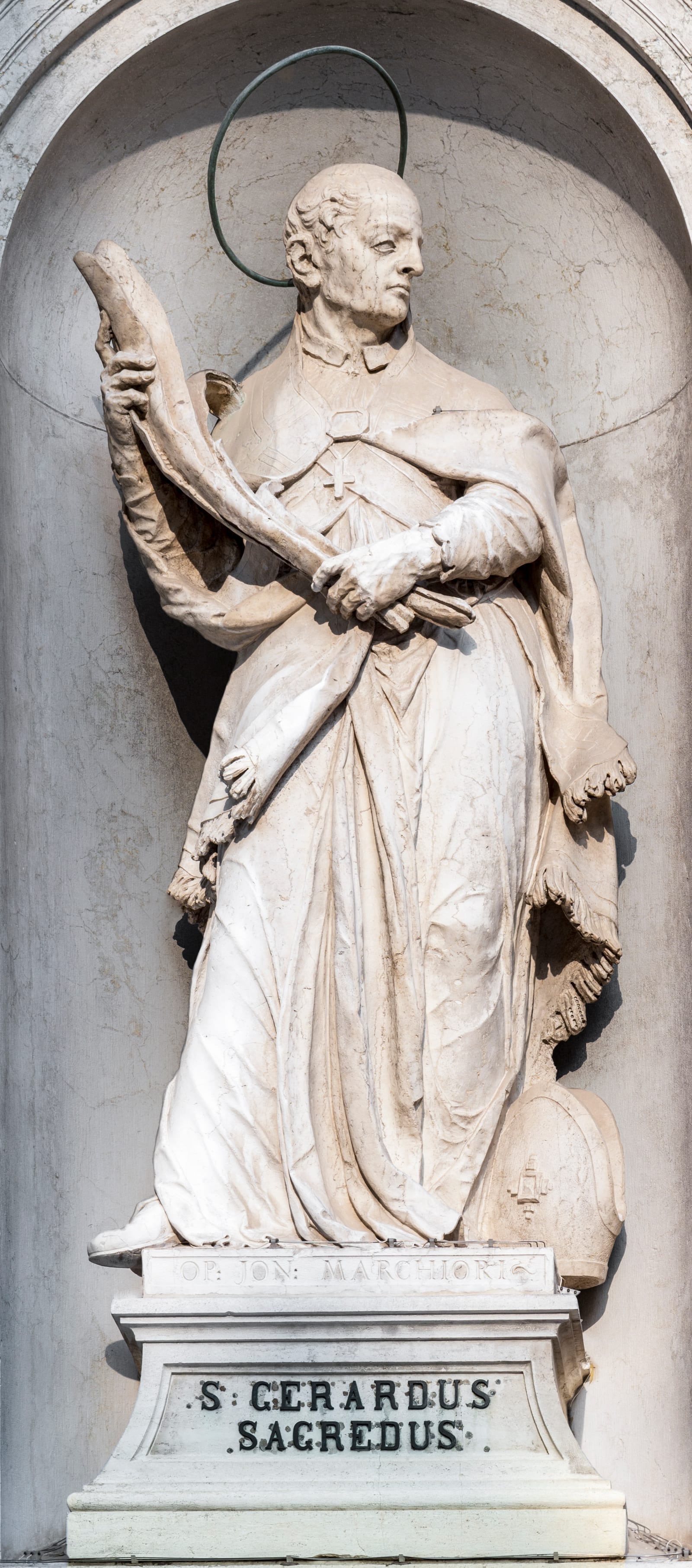
Gerard (Hungarian Gellért, Italian Gerardo) was born around 980 in Venice to a Venetian Italian noble family. Educated at the Abbey of San Giorgio Maggiore on the island in the Venetian lagoon (the Benedictine abbey founded by Doge Memmo around 982), he became a monk and around 1015 was elected abbot.
Around 1020, en route to the Holy Land on pilgrimage, Gerard's ship was driven by storm to the Dalmatian coast — and from there, guided by divine providence (per his hagiographical tradition), he proceeded north to the kingdom of Hungary, where the young King St. Stephen of Hungary recognized him as the divinely-sent missionary teacher for whom Stephen had been praying.
King Stephen appointed Gerard as tutor of his son Prince St. Imre (Emeric) — the young Hungarian royal whose Catholic formation under Gerard's direction produced the young saint-prince who would die in hunting accident in 1031 (before he could succeed Stephen on the Hungarian throne).
In 1030, after the decade of royal-tutor service, King Stephen appointed Gerard as the first Bishop of the new Diocese of Csanád (modern Cenad, Romania, in eastern Hungary near the confluence of the Maros and Tisza rivers) — the principal eastern-Hungarian diocese of the nascent Hungarian Catholic ecclesiastical organization.
For sixteen years (1030–1046) Gerard governed the Diocese of Csanád, establishing the cathedral school, the Benedictine monastic foundations, and the pastoral organization of the Hungarian Catholic eastern frontier.
After the death of King Stephen in 1038, the Hungarian throne underwent a decade of instability culminating in the pagan-Magyar Vata rebellion of 1046 — the anti-Catholic pagan revolt that attempted to restore the pre-Christian Hungarian pagan religion. On September 24, 1046, while crossing the Danube at Buda to meet the arriving King Andrew I (whose accession Gerard hoped would restore the Catholic order), Gerard was seized by the Vata pagan rebels: placed in a two-wheeled cart, he was pushed down the rocky hillside of Buda — the hillside that has borne his name as Gellért Hill (Gellérthegy) to the present day, the principal geographic landmark of Catholic Budapest.
His mass canonization in 1083 by Pope St. Gregory VII (simultaneously with St. Stephen of Hungary, St. Imre, and others) instituted the national-saint cult of the Hungarian Catholic royal-and-episcopal tradition.