
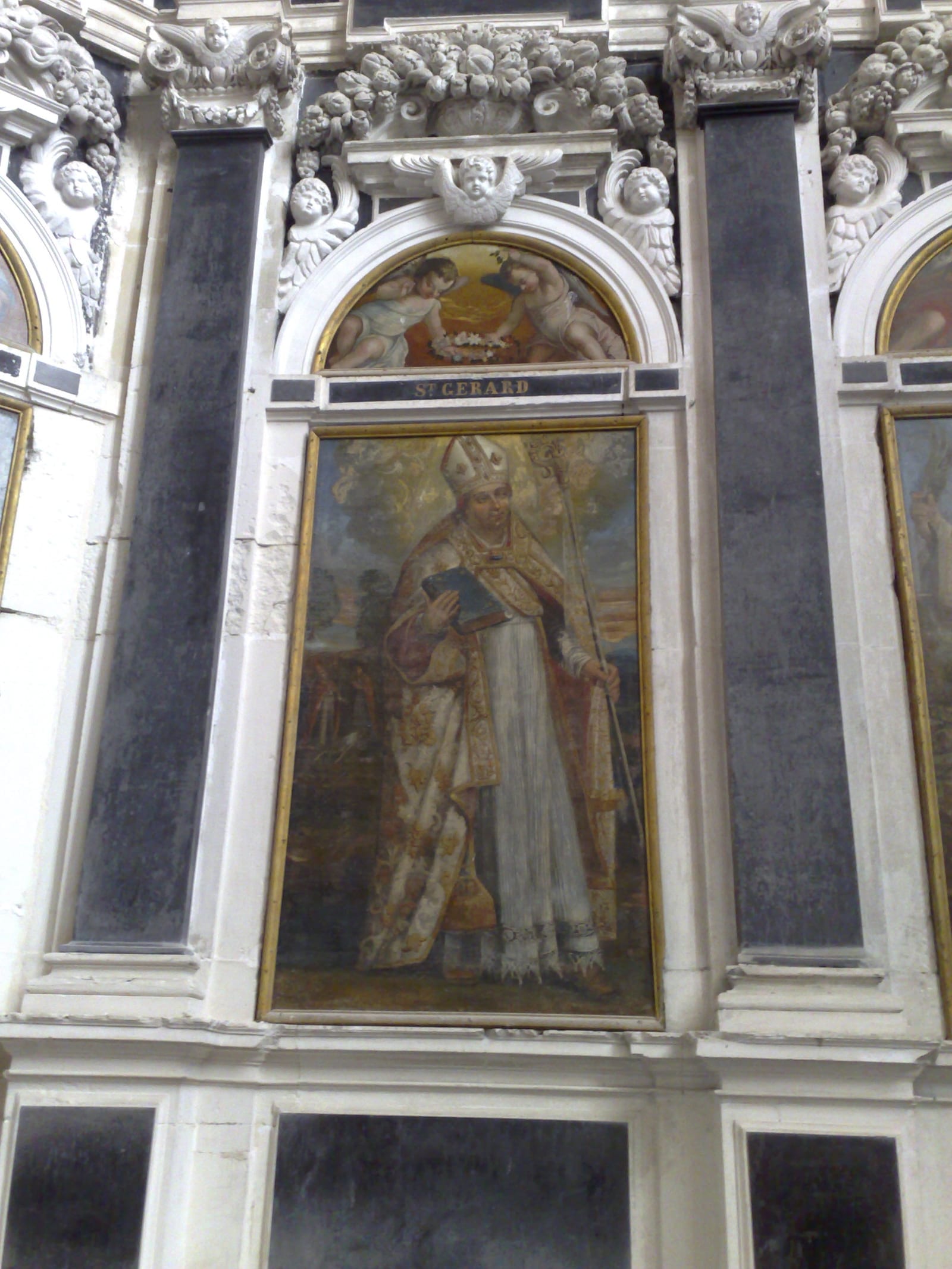
Gerard was born around 935 in Cologne to a noble Lotharingian-Ottonian family. Educated at the Cologne cathedral school under Archbishop St. Bruno the Great (the brother of Emperor Otto I), he became one of the distinguished young Lotharingian clerics of the Ottonian episcopal-imperial circle.
In 963, on the death of Bishop Gauzlin of Toul, Gerard was consecrated Bishop of Toul by Archbishop Bruno of Cologne — taking up the governance of the Lotharingian Catholic see of Toul (one of the three Lotharingian episcopal sees of Metz, Toul, and Verdun that shaped the medieval Lorraine Catholic identity).
His thirty-one-year episcopate (963–994) was devoted to the reform of the Toul cathedral and the expansion of the Lotharingian Catholic cathedral-school tradition. He established the Toul cathedral school — drawing scholars from Cologne, Reims, and Liège — and produced the generation of Lotharingian Catholic clerics who would underpin the 11th-century Catholic reform.
He rebuilt the Cathedral of Saint-Étienne at Toul (the predecessor of the current Gothic cathedral, begun 1221), established the monastic communities of Saint-Mansuy and Saint-Èvre at Toul, and undertook the pastoral visitation of the extensive diocese (which then covered most of the current Vosges and Meuse departments of France).
He died at Toul on April 23, 994. His canonization in 1050 by Pope Leo IX — himself a former Bishop of Toul who had personally known the continuing tradition of Gerard at his former cathedral — is a testimony to the continuing influence of the Gerard episcopal-reform tradition in the Lotharingian Catholic culture that produced the Gregorian Reform of the mid-11th century.