
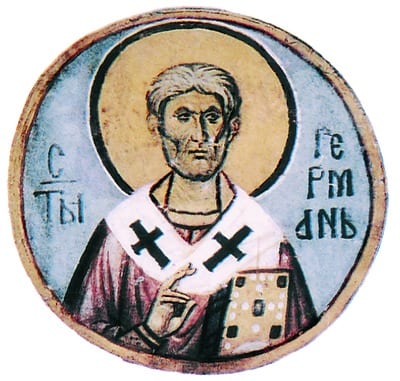
Germanus was born to a senatorial Constantinople family and made a eunuch as a youth — a common political precaution. Trained in the Church, he became bishop of Cyzicus and in 715 was elevated to the patriarchal throne of Constantinople — the most senior bishopric of the Eastern Roman empire.
His twenty-one-year patriarchate began in peace but turned to bitter conflict when the Emperor Leo III the Isaurian in 726 launched the Iconoclast campaign — ordering the destruction of all sacred images in churches throughout the empire. Germanus resisted publicly, refusing to sign the imperial edict, and in 730 was deposed by the emperor.
He retired to his family estate at Platanion in Asia Minor, where he wrote his famous Letter to Pope Gregory II that became the foundational document of the iconodule (image-honoring) position. He died there at over a hundred years of age in 740. His position was vindicated at the Second Council of Nicaea (787), and posthumously he was hailed as the proto-confessor of the orthodox veneration of icons. The Byzantine Church commemorates him on the first Sunday of Lent — the Triumph of Orthodoxy — with all the great defenders of the icons.