
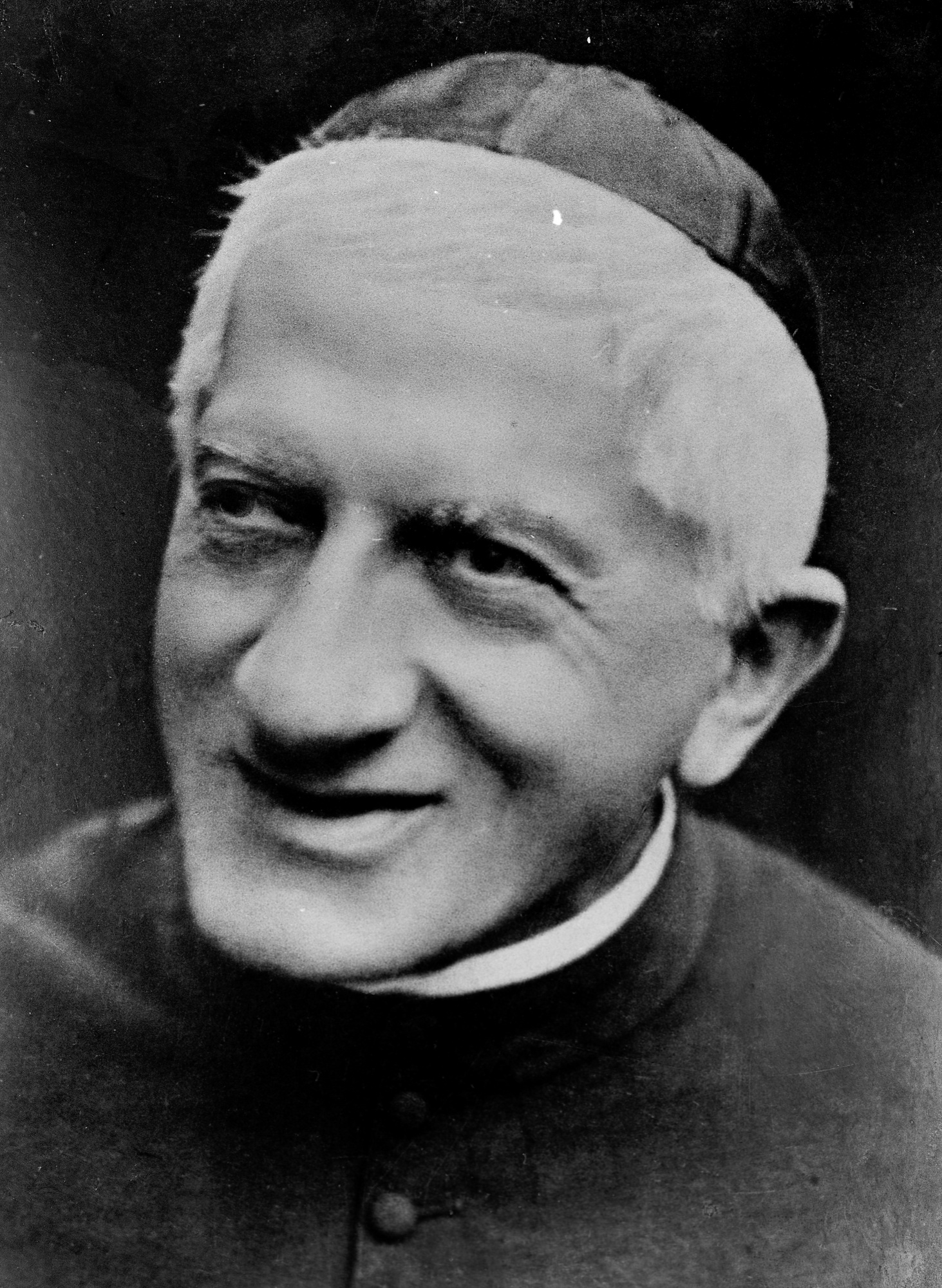
Giuseppe Allamano was born on January 21, 1851 at Castelnuovo d'Asti, the fourth of five children. His father died before he was three. His mother, Maria Anna Cafasso, was the younger sister of St. Joseph Cafasso, the Turin priest who accompanied condemned men to the gallows; the boy met his uncle once, at six, and kept him as a model for life. In the autumn of 1862 he entered Don Bosco's oratory at Valdocco for his secondary schooling, and Don Bosco was his confessor for four years. When he left without warning for the diocesan seminary, Don Bosco told him gently that he had done him wrong by not saying goodbye.
He entered the seminary in 1866 against his family's wishes and was ordained on September 20, 1873 by Archbishop Lorenzo Gastaldi. After a few months in a parish he was sent back to the seminary as an assistant, and at twenty-five was made its spiritual director; he took his doctorate in theology in 1876.
In October 1880, at twenty-nine, he accepted the post nobody wanted: rector of the Sanctuary of the Consolata, Turin's Marian shrine, which was falling into ruin and whose attached Convitto Ecclesiastico — the house where newly ordained priests finished their formation, and where Cafasso had once taught — was in trouble. He rebuilt both. He held the rectorship for forty-six years, until his death, and reopened the Convitto in 1882, running it himself. He was helped through all of it by Canon Giacomo Camisassa, his collaborator for forty-two years; when Camisassa died Allamano said he had lost both his arms.
He had wanted to be a missionary since boyhood and his health had never allowed it. A near-fatal illness in January 1900 settled the matter differently: with the backing of Archbishop Agostino Richelmy and the Piedmontese bishops he founded the Institute of the Consolata Missionaries on January 29, 1901, so that Turin's own priests could go to Africa. The first four left for Kenya on May 8, 1902. For a while the women's work was done by Cottolengo sisters; then Pius X told him plainly that he must found missionary sisters himself, and on January 29, 1910 he founded the Consolata Missionary Sisters.
He never went to Africa. He governed both institutes by letter, ran the shrine, the Convitto, the clergy retreats at Sant'Ignazio above Lanzo, a Catholic press, and the causes for his uncle, whom he saw beatified on May 3, 1925. He taught that every priest is a missionary by nature and that the missionary vocation differs from the priestly one in nothing but 'great love for God and zeal for souls.'
He died at the Consolata on February 16, 1926 and was buried in Turin's general cemetery two days later. On October 11, 1938 his remains were brought to the Mother House on Corso Ferrucci, where they rest in a sarcophagus that serves as the altar of the chapel now named for him, Camisassa's tomb beside it. John Paul II beatified him in St. Peter's Square on October 7, 1990, and Pope Francis canonised him on October 20, 2024, Mission Sunday, together with Marie-Léonie Paradis, Elena Guerra, and the martyrs of Damascus.