
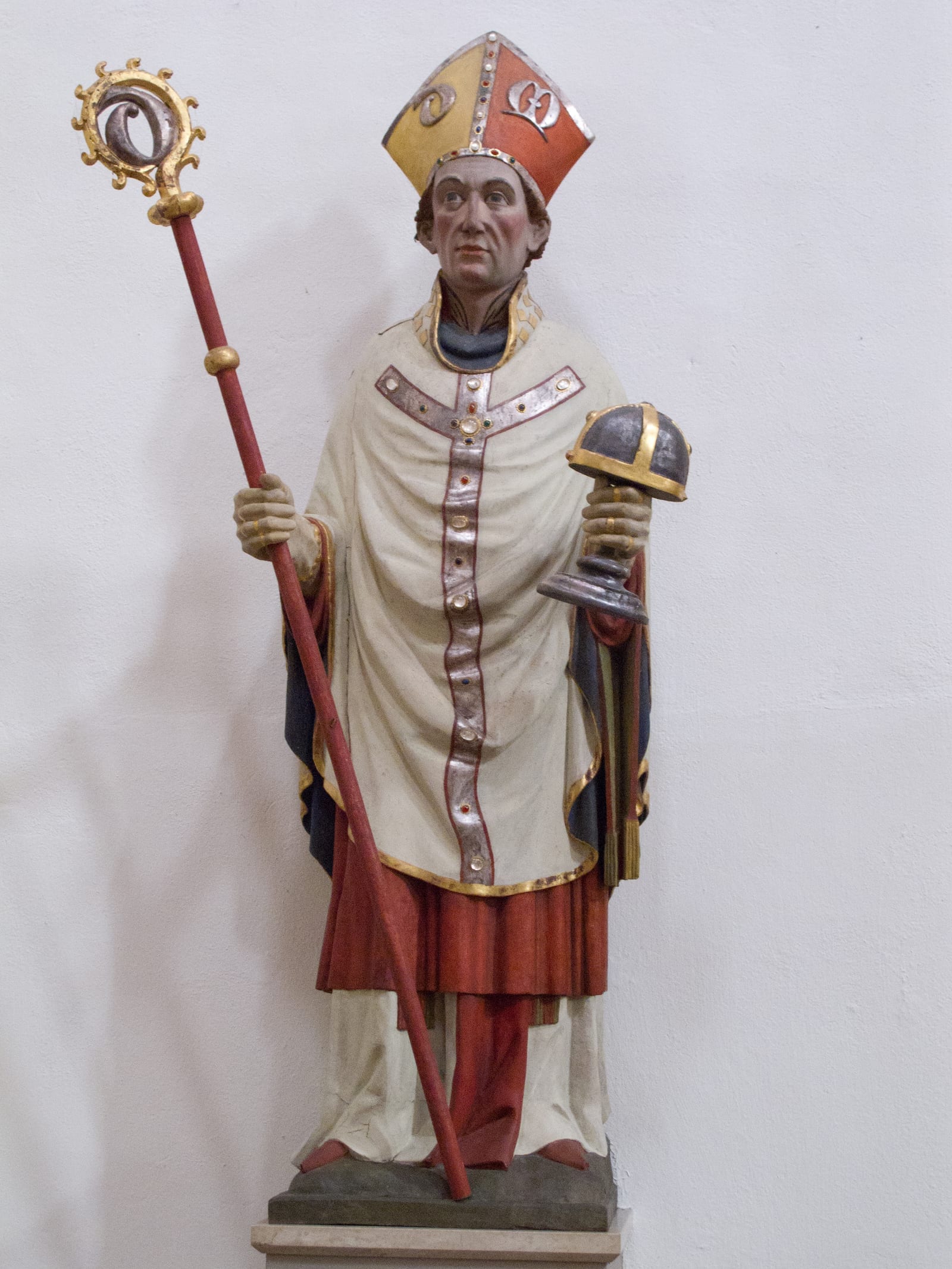
Godehard (Latin Godehardus, Gotthard) was born around 960 to a Bavarian ministerial family attached to the Abbey of Niederaltaich on the Danube — the principal monastic centre of Bavaria. Educated at the abbey school, he entered the community as a monk around 990 and became abbot of Niederaltaich in 996.
Under his governance, the Niederaltaich Abbey became the principal Bavarian centre of the Cluniac reform — and at the request of Emperor St. Henry II, Godehard undertook the reform of multiple additional Bavarian monastic communities (Tegernsee, Hersfeld, Kremsmünster), producing the characteristic Bavarian-Cluniac monastic discipline of the early 11th century.
In December 1022, on the death of St. Bernward of Hildesheim, Emperor Henry II appointed Godehard as Bishop of Hildesheim — bringing the Bavarian-Cluniac monastic-reform tradition to the Lower Saxon episcopal see. Godehard governed Hildesheim for sixteen years (1022–1038), continuing the Bernwardian artistic-and-liturgical reform tradition while adding the specifically Cluniac monastic-disciplinary element.
He consecrated the Abbey Church of St. Michael at Hildesheim (begun by Bernward, consecrated by Godehard in 1033) — the architectural masterpiece of the Ottonian period and an UNESCO World Heritage Site.
He died at Hildesheim on May 5, 1038. His canonization in 1131 by Pope Innocent II — the first formal papal canonization of a German saint since Sts. Ulrich of Augsburg (993) — instituted his cult; his Basilica of St. Godehard at Hildesheim (built 1133–1172) survives in continuous Catholic liturgical use as a principal Hildesheim pilgrim destination.
The famous Alpine Gotthard Pass (St. Gotthard Pass, the principal Alpine pass between the Swiss Canton of Uri and the Italian Canton of Ticino) was named for Godehard in the 13th century when the pilgrim hospice at the pass-summit was placed under his dedication — making him the namesake of the pass that would remain one of the principal Alpine transport routes through the centuries (the famous Gotthard Rail Tunnel of 1882 and the Gotthard Base Tunnel of 2016 — the longest railway tunnel in the world — bearing the saint's name).