
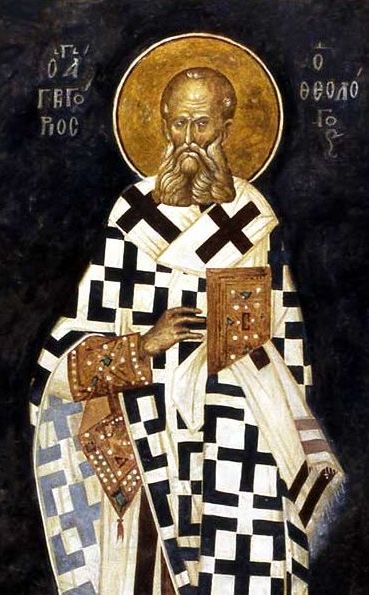
Gregory was the son of the bishop of Nazianzus in Cappadocia. With Basil he studied at Athens — they shared a room and a deep friendship — and through Basil he was drawn first to monastic retreat, then reluctantly to the priesthood and the episcopate. He preferred the desert; the Church kept calling him out of it.
His great moment came in 379, when the small orthodox community of Constantinople — almost entirely overwhelmed by Arianism after decades of pro-Arian imperial policy — called him to be their pastor. He arrived to find a single house-church, the Anastasis ('Resurrection'). From that pulpit he delivered the five Theological Orations that earned him the unique title in the Greek Church of 'the Theologian' (a title given only to him, to John the Evangelist, and to Symeon the New Theologian).
He presided briefly at the First Council of Constantinople (381), which completed the Nicene Creed in the form we still say each Sunday. Personal politics and exhaustion drove him to resign and return to Nazianzus, where he spent his final years in retreat, writing some of the finest religious poetry in the Greek language.