
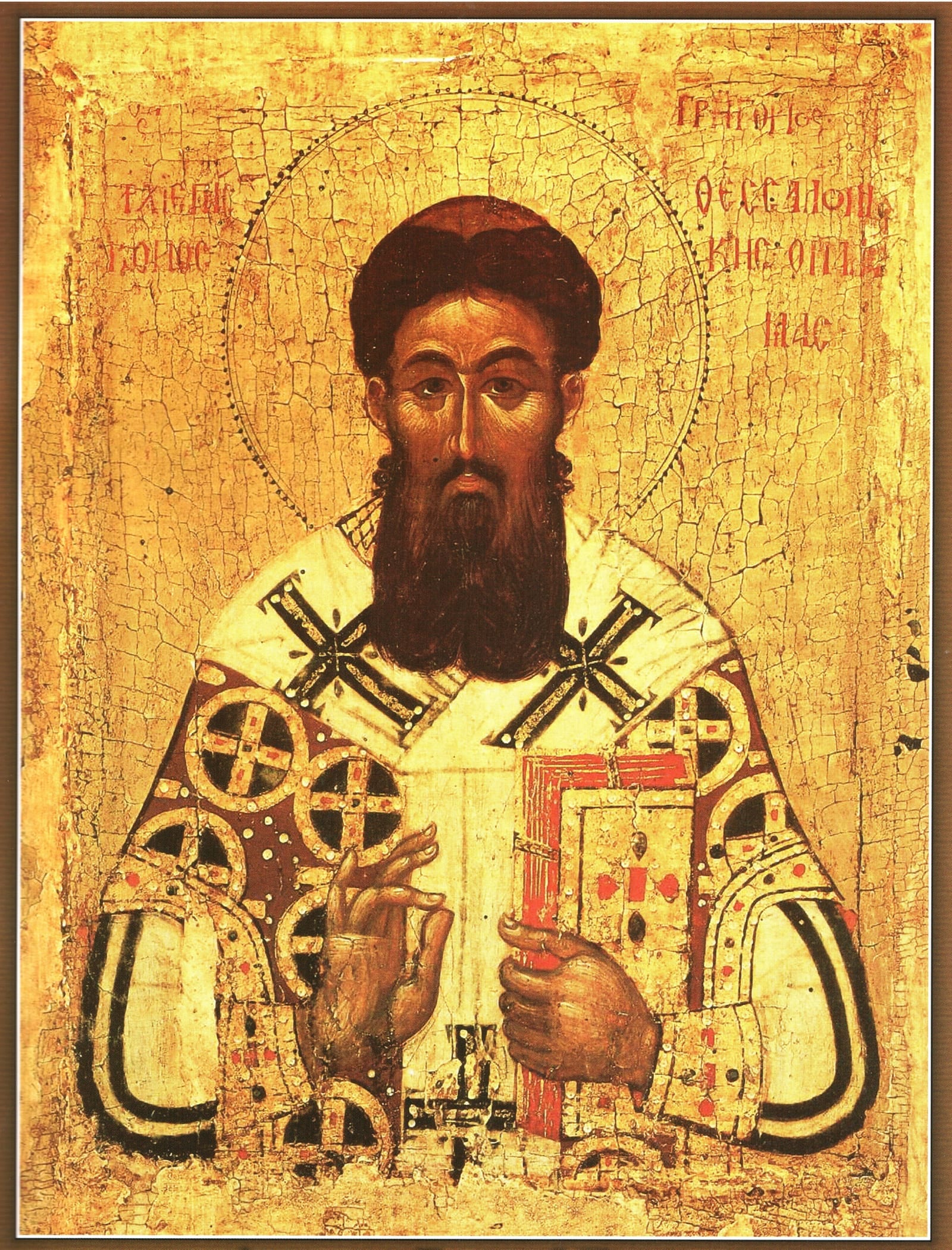
Gregory Palamas was born to a senatorial Constantinopolitan family and educated at the imperial palace school under the philosopher Theodore Metochites. He renounced a court career at twenty and entered the Athonite monastery of Vatopedi, then the Great Lavra. He became the principal theological defender of hesychasm — the contemplative practice of the Athonite monks involving the Jesus Prayer, controlled breathing, and the seeking of the experience of God as the Uncreated Light of Tabor.
When the Calabrian Greek philosopher Barlaam of Seminara attacked the Athonite practice as crude superstition (the monks were 'omphaloscopists,' navel-gazers, claiming to see God with their bodily eyes), Gregory replied with the Triads in Defence of the Holy Hesychasts (1338) — the systematic theological exposition of the distinction between God's transcendent essence (which remains forever unknowable) and his divine energies (in which the saints really do participate). The thesis was confirmed at the Councils of Constantinople of 1341, 1347, and 1351, the 'Palamite synods.'
Gregory was elected Archbishop of Thessalonica in 1347 but could not take possession of his see for three years because of political turmoil. He was captured by Turkish pirates in 1354 and held for ransom for a year, during which he wrote extensively, including a series of dialogues with Turkish theologians. He returned to Thessalonica and died there in November 1359. He was canonized in 1368 — only nine years after his death — and his theology, briefly contested in the West, became the doctrinal foundation of all subsequent Eastern Orthodox spirituality. The second Sunday of Great Lent is dedicated to him in the Byzantine calendar — a second 'Sunday of Orthodoxy.'