
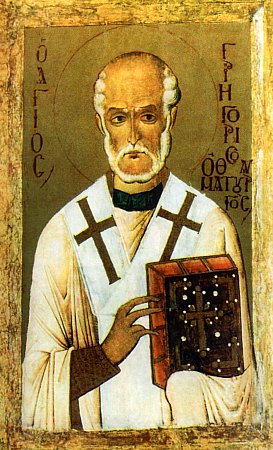
Gregory (Greek Grēgorios, originally Theodoros — 'gift of God' — taking the new name at his baptism) was born to a wealthy pagan Greek family of Neocaesarea in Pontus (the northern coast of Asia Minor on the Black Sea). At nineteen he and his brother Athenodorus travelled to Caesarea Palaestinae to study Roman law with the famous jurist Berytus; there they encountered Origen, who had recently relocated from Alexandria, and both brothers converted to Christianity. Gregory spent five years (c. 233–238) as Origen's personal pupil at Caesarea — one of the most consequential teacher-pupil relationships of early Christian intellectual history.
Gregory's farewell speech to Origen (Oratio Panegyrica in Origenem) — delivered at his departure from Caesarea around 238 and preserved intact — is the most extensive early Christian description of the master-pupil relationship in the patristic period and the most extensive personal description of Origen by anyone who knew him.
Returning to Pontus, Gregory was elected Bishop of Neocaesarea around 240 and governed the see for thirty years. At his appointment, the Christian community of Neocaesarea consisted (according to his biographer-namesake Gregory of Nyssa) of seventeen Christians; at his death thirty years later, the city of Neocaesarea was almost entirely Christian and only seventeen pagans remained — the foundational story of mass Catholic conversion of a pagan Pontic city.
He earned the title Thaumaturgus ('Wonder-Worker') from the extraordinary dossier of miracles attributed to him in his lifetime: redirecting the Lycus River away from flooding the city, drying a swamp, moving a mountain (the most famous — preserved by Gregory of Nyssa — Gregory ordered an obstructing mountain near Neocaesarea to move in the name of Christ, and it visibly did, opening the road for the local agriculture), commanding earthquakes, and his Marian vision at Neocaesarea around 245 — the first attested Marian apparition in Catholic Christian tradition, in which the Virgin Mary, attended by John the Evangelist, dictated to him the Creed of Neocaesarea (one of the earliest formal Christian creedal formulations).