
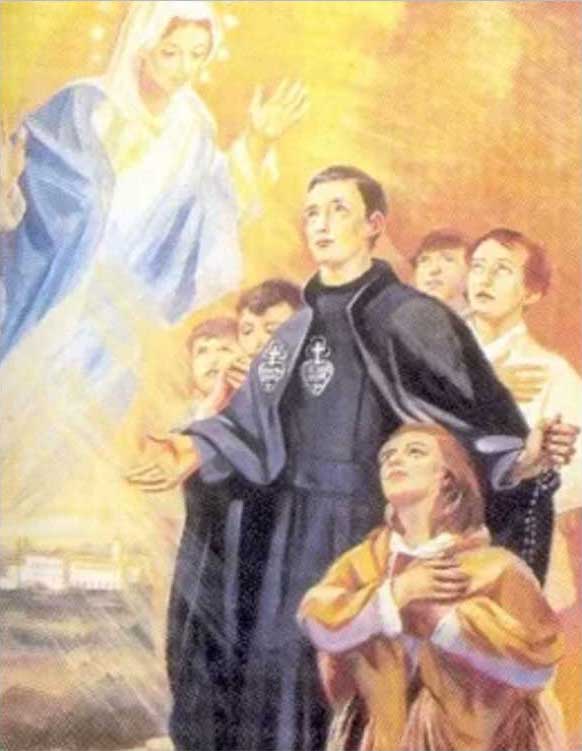
Ferdinando Santamaria was born on 4 May 1883 at Pontecorvo, in the Liri valley south of Frosinone, and baptised the next day. He was the eldest of five children of Pietro Paolo Santamaria and Cecilia Ruscio, who made rope from hemp. He made his First Communion at eight, joined a parish sodality at nine, and after elementary school learned his Latin, grammar and rhetoric from a priest of the town, Don Antonio Roscia, often reading by candlelight to make up for what he lacked.
The pull was the Passionists. Their retreat at the shrine of the Madonna delle Grazie stood just outside Pontecorvo, and the boy went there more and more, drawn by the austerity of the life; his father resisted the vocation for some time. On 15 February 1899, not yet sixteen, he left home for the Passionist novitiate at Paliano, and on 5 March he received the black habit with the white Sign of the Passion, taking the name Grimoaldo of the Purification — Grimoald being the patron saint of Pontecorvo.
He professed his vows on 6 March 1900 and the next day was sent to the Badia of Santa Maria di Corniano at Ceccano to begin the classical studies that led to the priesthood. The studies did not come easily. His biographers remember him as cheerful through the humiliations and setbacks of the classroom, and his fellow students noticed that he did nothing different from them but did it with a growing intensity of love. He kept to a few plain rules: God first; gratitude to the Crucified shown in concrete penance and humility; perseverance whatever it cost; austerity and contentment; and being always available to the others. He liked to say that he thought always of Jesus climbing Calvary and of his Mother following after, and wanted to follow their sufferings.
On 31 October 1902, on an afternoon walk, in perfect health until then, he was seized by what the following day was diagnosed as acute meningitis. He died quietly on 18 November 1902, nineteen and a half years old, and was buried the next day in the cemetery at Ceccano. His memory did not fade at the Badia; the cause was opened in 1954, and in October 1962 his remains were exhumed from the cemetery and brought into the convent church. In the habit he was buried in was found a scrap of cloth and a note: a relic of the habit of the Venerable Gabriel of the Sorrows, the Passionist student who had died young at Isola del Gran Sasso forty years before him.
John Paul II declared his virtues heroic on 14 May 1991. On 2 July 1994 the miracle was approved: on 15 May 1982 at Cesa, in the province of Caserta, a small boy named Nicola had been run over by a tractor, the rear wheel passing over his chest and head, and his father, who had once been a Passionist, called on Grimoaldo; the doctors who examined the child could not explain why he was unhurt. On 29 January 1995, in St. Peter's Basilica, the Pope beatified him with Rafael Guízar y Valencia, Modestino of Jesus and Mary and Genoveva Torres Morales, and held him up to the young as a model of a simple, generous holiness anchored in the Paschal mystery of Christ. On 8 February his urn was carried back to Ceccano and set in a new chapel on the left side of the church. His feast is 18 November.