
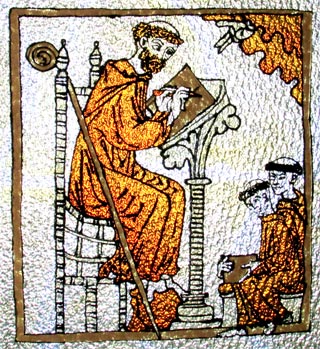
Guerric was born around 1075 to a noble Flemish family at Tournai. After early secular education, he became a secular master at the cathedral school of Tournai — one of the principal Flemish-Hainault cathedral schools of the period.
Around 1125, having heard of St. Bernard of Clairvaux's spiritual reputation, Guerric travelled to the Cistercian Abbey of Clairvaux for what he intended to be a brief consultation with Bernard. Captivated by the Clairvaux discipline and the personal magnetism of Bernard, Guerric remained at Clairvaux as a Cistercian monk for the thirteen years.
In 1138, at the age of approximately 63, Guerric was elected by Bernard's designation as second Abbot of the Cistercian Abbey of Igny in Champagne (a filial of Clairvaux founded in 1128). His nineteen-year abbacy at Igny (1138–1157) was devoted to the consolidation of the Igny community and to the composition of his principal homiletic-theological works.
Guerric's principal literary legacy is the Sermons of Guerric of Igny — 54 surviving Latin Cistercian sermons for the liturgical year, one of the principal corpora of 12th-century Cistercian homiletic-theology. The Sermons cover the principal feasts of the liturgical year (Advent, Christmas, Epiphany, Lent, Easter, Ascension, Pentecost, and the Marian feasts of Annunciation, Purification, Assumption) and are distinguished by the rich Patristic-Scriptural learning, the characteristic Cistercian Christological-Marian-mystical themes, and the elegant Latin homiletic style.
The Sermons circulated widely in the medieval Cistercian-Latin Catholic tradition (over 60 surviving medieval manuscripts) and became one of the principal sources of the Cistercian-mystical and the broader Catholic-homiletic tradition. Guerric is venerated alongside Sts. Bernard of Clairvaux, William of Saint-Thierry, and Aelred of Rievaulx as one of the 'Four Evangelists of Cîteaux' — the four principal 12th-century Cistercian theological-spiritual writers.
He died at Igny on August 19, 1157.