
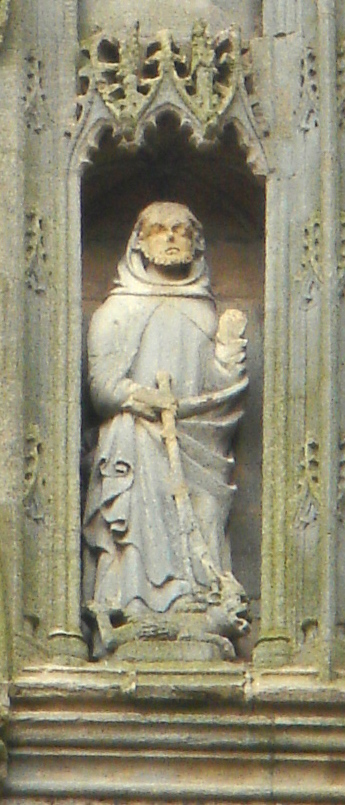
Guthlac (Old English Gūðlāc, 'reward of battle') was born in 673 to a noble Mercian warrior family of the Guthlacingas — descendants of the legendary King Icel. From age fifteen he led his own war-band, raiding the Welsh borders for nine years and acquiring substantial wealth.
Around 695, struck by sudden religious conversion (Bede-tradition tells he reflected on the deaths of the warriors who had preceded him), he abandoned warfare, gave his treasure to his men, and took the tonsure at Repton under Abbess Ælfthryth.
After two years at Repton, seeking greater solitude, he set out by boat into the Lincolnshire fens with two companions and settled on the desolate island of Crowland (Croyland) on the feast of St. Bartholomew, August 24, 699 — establishing his hermitage on a Roman-British burial mound.
For fifteen years until his death on April 11, 714, he lived as a fen-anchorite, fasting on barley bread and muddy water, plagued (per the contemporary Vita of Felix) by demonic apparitions in the form of British-speaking devils (a vivid hagiographical reflection of the Anglo-Saxon settler experience). He was visited by the future King Æthelbald of Mercia (then a fugitive from Ceolred), to whom he prophesied future kingship — a prophecy fulfilled in 716.
After his death, his sister St. Pega (see below) buried him; King Æthelbald, on his accession, founded the great Abbey of Crowland (Croyland) on the site, which became one of the wealthiest Benedictine houses of medieval England.