
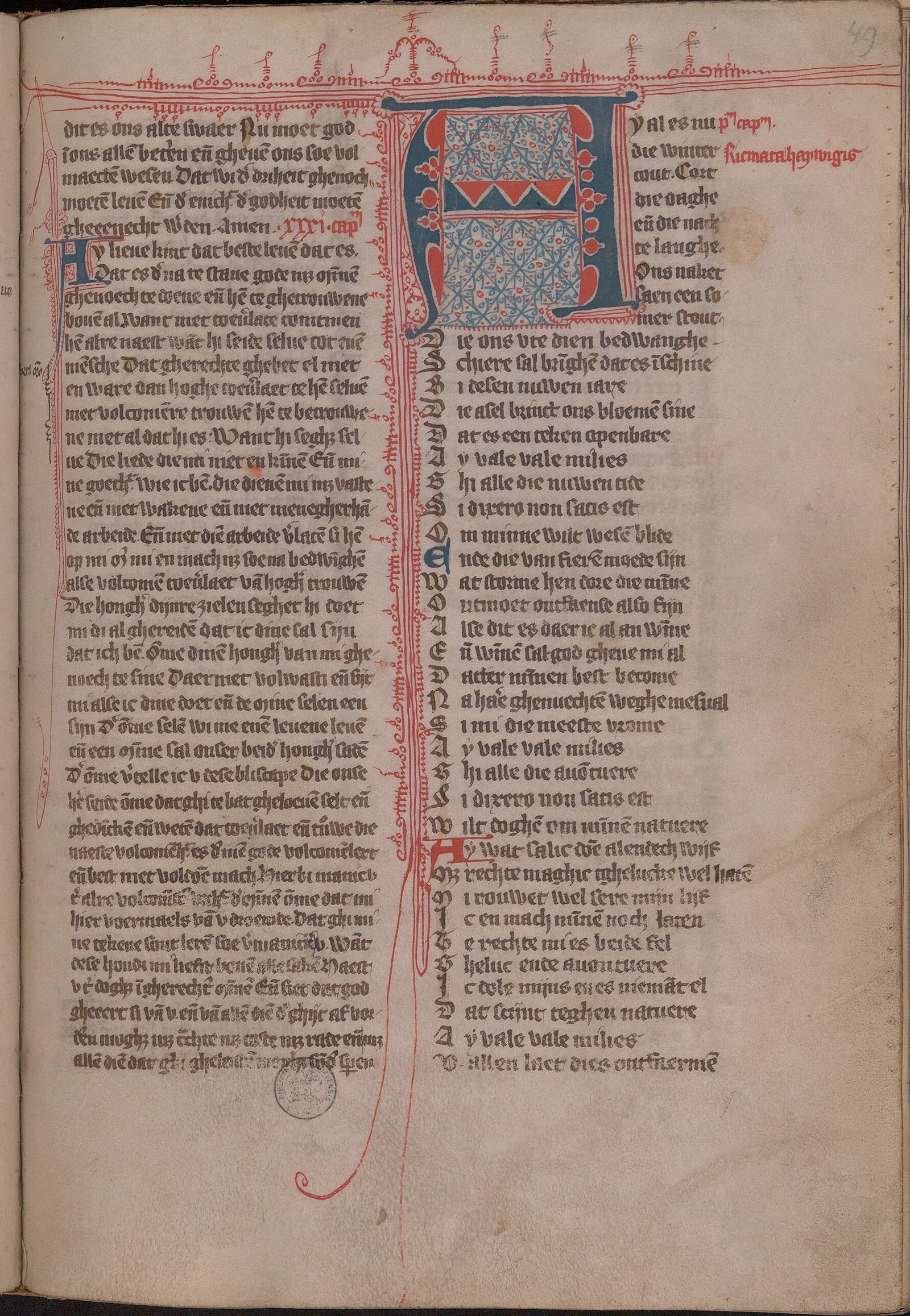
Hadewijch (Dutch Hadewijch, sometimes anglicized as Hadewych of Antwerp) is one of the most influential — and one of the most historically obscure — medieval Catholic women's-mystical writers.
little is known of her biographical circumstances: she was born around 1200 to a noble Brabantine family (possibly at Antwerp or Brussels), received a thorough Latin and vernacular education (the quality of her vernacular Middle Dutch writing suggests aristocratic-scholastic formation), and undertook the Beguine vocation — the distinctive Brabantine lay-women's-religious movement of the early 13th century.
Hadewijch served as magistra (spiritual director-superior) of a Brabantine Beguine community — the community-location not preserved in the surviving records. Her leadership produced conflicts with the broader ecclesiastical authorities, and she appears to have been expelled or to have voluntarily left her Beguine community in her later years.
She died sometime around 1248, in obscurity. Her writings were preserved by the Brabantine Beguine tradition and survived in the limited manuscript-transmission through the late medieval and early modern periods — without institutional papal recognition, memory of Hadewijch continued only in the Brabantine Beguine oral tradition.
Her literary corpus — rediscovered by modern Belgian scholarship in the late 19th century — consists of four major collections:
1. Poems in Stanzas (Liederen) — forty-five Middle Dutch vernacular strophic poems, the earliest known collection of Middle Dutch vernacular religious lyric poetry, in the courtly-love (minne) idiom adapted to the Catholic mystical-Marian theme.
2. Poems in Couplets (Mengeldichten) — sixteen Middle Dutch vernacular didactic-mystical poems.
3. Visions (Visioenen) — fourteen Middle Dutch vernacular prose accounts of Hadewijch's mystical-ecstatic visions.
4. Letters (Brieven) — thirty-one Middle Dutch vernacular letters of spiritual direction addressed to members of Hadewijch's Beguine community and other spiritual correspondents.
The Hadewijch corpus is one of the principal medieval Catholic women's-vernacular-mystical writings — in institutional parallel with the contemporary Middle Low German writings of Bl. Mechthilde of Magdeburg (The Flowing Light of the Godhead, c. 1250–1282) and the contemporary Latin writings of Sts. Mechtilde of Hackeborn and Gertrude the Great at Helfta.
Hadewijch's literary contribution — the courtly-love idiom applied to the Catholic mystical-Marian theme — institutionally established the 'minne mysticism' (minne-mystiek) tradition of the Brabantine and Rhineland women's-mystical writing that would extend through the late-medieval mysticism.
Her writings influenced the great Brabantine mystic Bl. Jan van Ruysbroeck (1293–1381, the principal 14th-century Brabantine mystical theologian, whose works show the unmistakable Hadewijch-influence).