
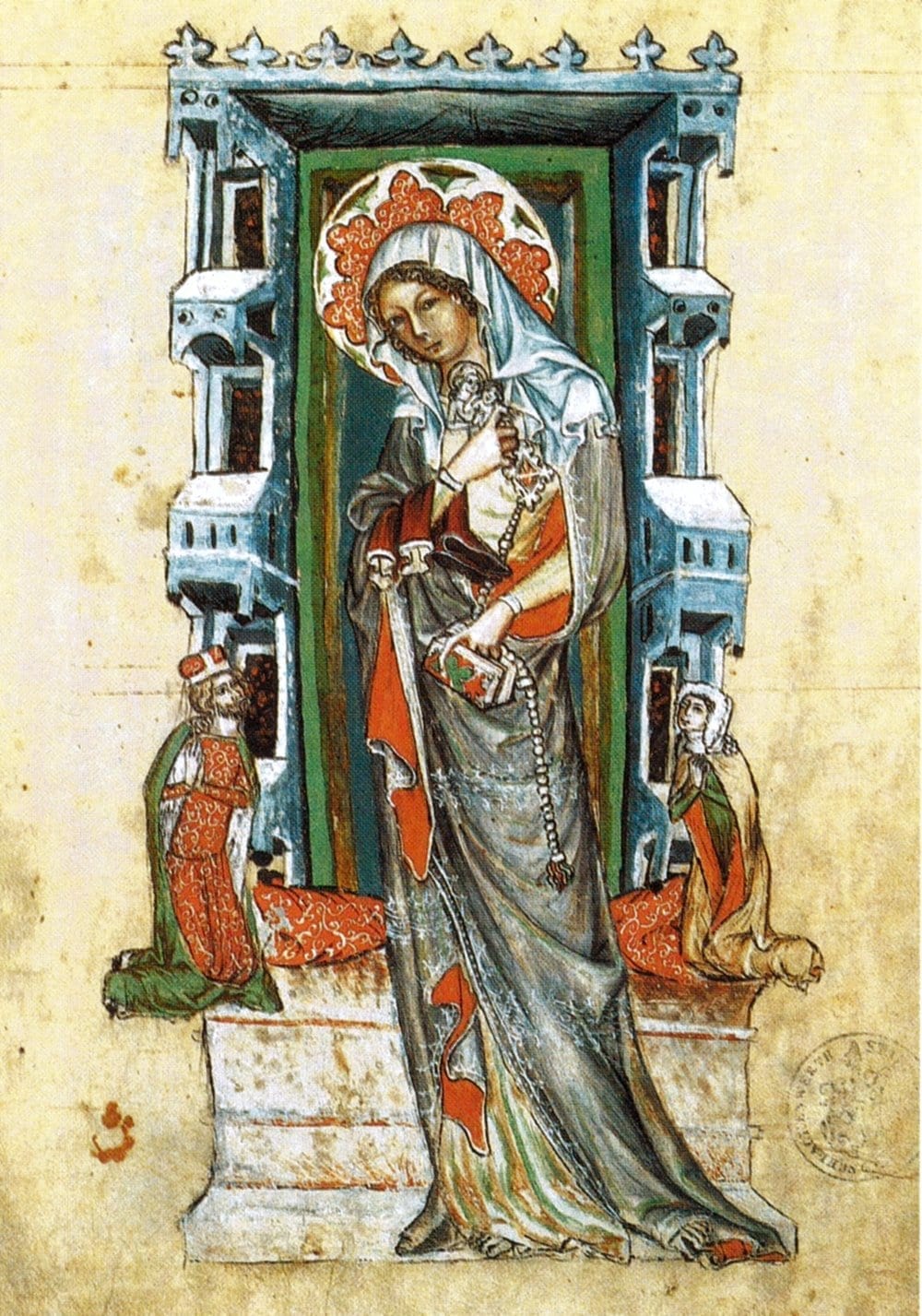
Hedwig was born at Andechs, daughter of Count Berthold IV of Andechs-Meranien and aunt of St. Elizabeth of Hungary. At twelve she was married to Henry I 'the Bearded,' Duke of Silesia, with whom she had seven children. After the seventh she persuaded Henry to take a vow of chastity with her, which they observed until his death.
She founded the first Cistercian nunnery on Polish soil at Trzebnica in 1202 — staffed initially with nuns from her family's Bavarian foundations, and the great vehicle by which Cistercian observance, Gothic architecture, and German colonisation entered Silesia. She supported Franciscan and Dominican foundations across the duchy, brought Italian masons to Silesia, and was the principal architect of the cultural-religious bridge between Polish-Slavic and German-Latin Catholic worlds that defined medieval Silesia.
After Henry's death in 1238 she took the Cistercian habit at Trzebnica. The Mongol invasion of 1241 killed her son Henry II 'the Pious' at the battle of Legnica; she was at the abbey when news arrived and is said to have already foreknown his death in a vision. She died at Trzebnica two years later and was canonized in 1267. Her cult became one of the most powerful in central Europe; in 1773 Frederick the Great rebuilt the Catholic cathedral of Berlin and dedicated it to her — St. Hedwig's Cathedral has been the principal Catholic church of Berlin ever since.