
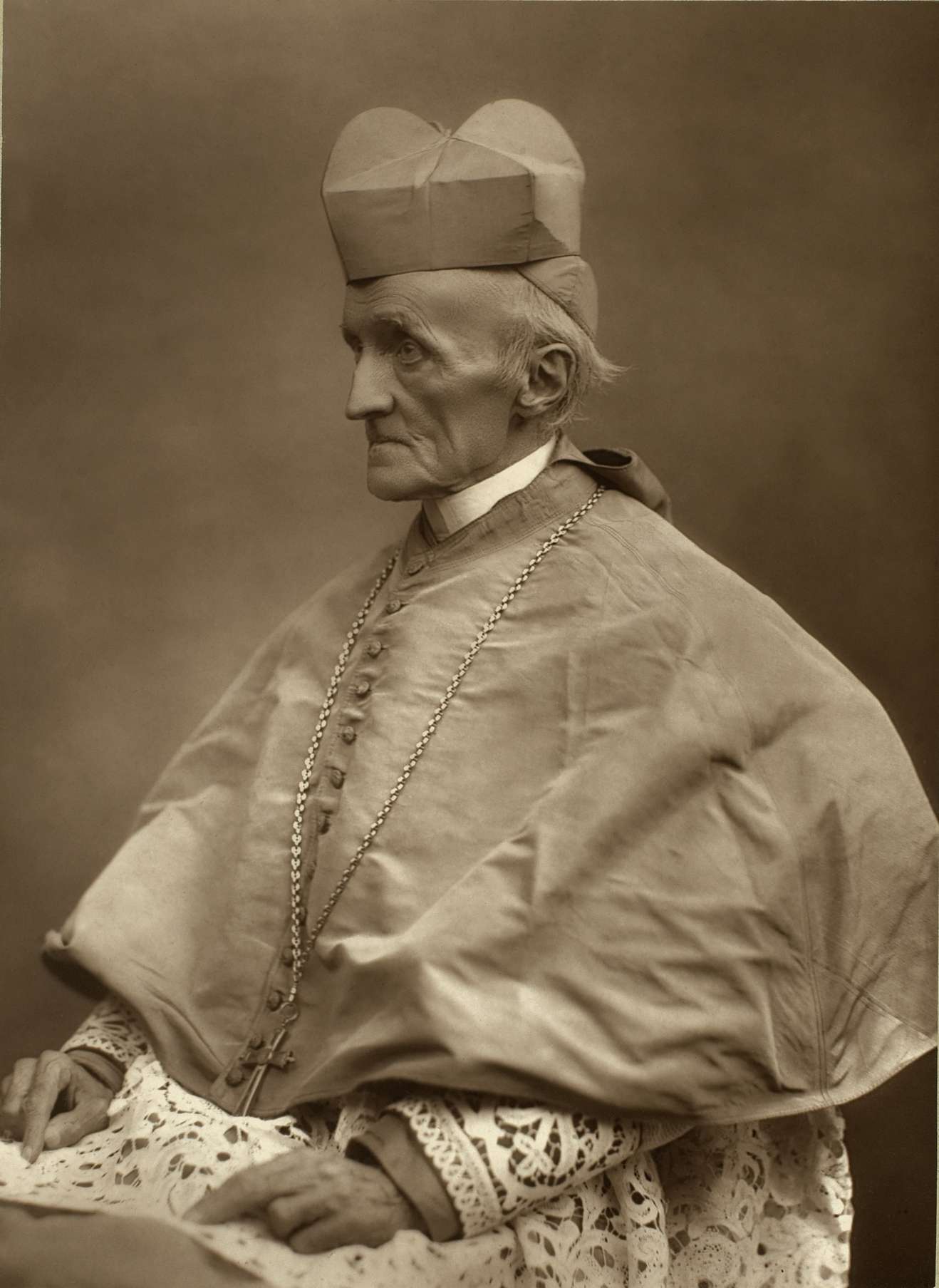
Henry Edward Manning was born on July 15, 1808 at Copped Hall in Hertfordshire to a Manning Anglican family (father William Manning was Governor of the Bank of England). Educated at Balliol College, Oxford, Henry became Anglican priest in 1832.
Henry served as Anglican Archdeacon of Chichester (1840–1851) — becoming one of the leading Anglican churchmen of the Victorian era. Under the influence of the Oxford Movement (the Newman-Pusey Anglo-Catholic revival of the 1830s–1840s), Henry underwent the systematic conversion to Catholicism.
On April 6, 1851 — after the Gorham Judgment of 1850 (the Anglican canonical decision that denied the sacramental efficacy of baptism) — Henry converted to Catholicism. Ordained Catholic priest in 1851, Henry undertook the systematic Catholic ministry.
In 1865, Henry was consecrated Archbishop of Westminster — the principal Catholic archdiocese in England. Created Cardinal in 1875, Henry served as Cardinal Archbishop of Westminster for 27 years (1865–1892).
Cardinal Manning became famous for his Catholic social-doctrine engagement — intervening in the London Dock Strike of 1889 as personal mediator between the strikers and the dock companies, producing the settlement that established the Catholic support for the British labor-union movement. Manning personally collaborated with Pope Leo XIII on the Rerum Novarum (1891) — the principal encyclical of Catholic social doctrine.
Manning became famous for his Catholic educational engagement — establishing multiple Catholic schools for the Irish immigrant working-class community of London.
He died at London on January 14, 1892.