
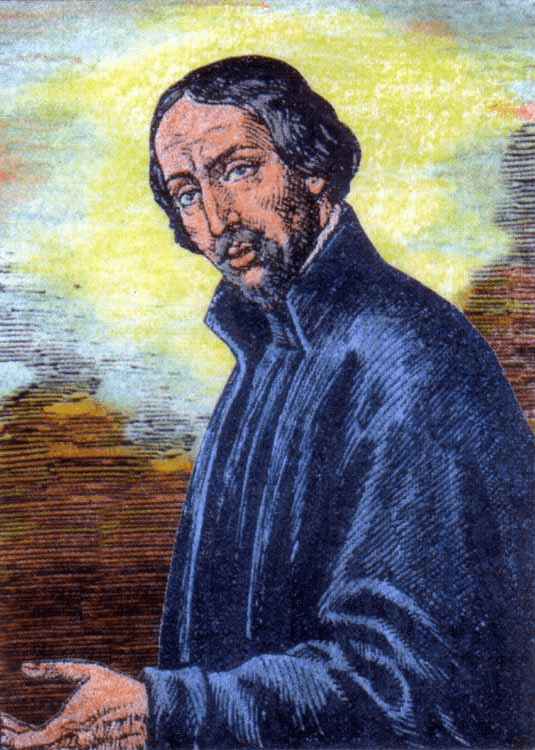
Henry Morse was born to a Norfolk Protestant family, studied at Cambridge, converted to Catholicism at twenty, and went to the English seminary at Douai in 1614. After several years in continental Jesuit formation he was ordained priest at Rome in 1623 and returned to England that year, but was almost immediately arrested in Newcastle and imprisoned for nearly three years before being banished to the Continent.
He returned clandestinely to England in 1633 and worked the London recusant networks for the next four years until arrested again in 1636 and banished a second time. Returning yet again in 1640, he laboured through London plague seasons — particularly the major outbreak of 1636–37 — in unprotected ministry to plague-stricken Catholics, contracting the plague three times and recovering. London Anglicans of the period referred to him as 'the priest of the plague,' often with respect.
He was arrested for a fourth time in Cumberland in 1644, brought to London, and tried in early 1645 — found guilty of being a priest and refusing the Oath of Allegiance to the Puritan Parliament. He was dragged to Tyburn on February 1, 1645, in a procession joined by representatives of the French and Portuguese embassies (who watched the execution from their carriages in protest). On the gallows he prayed silently for the conversion of England and was executed alongside two laypeople with the usual brutality. Canonized 1970.