
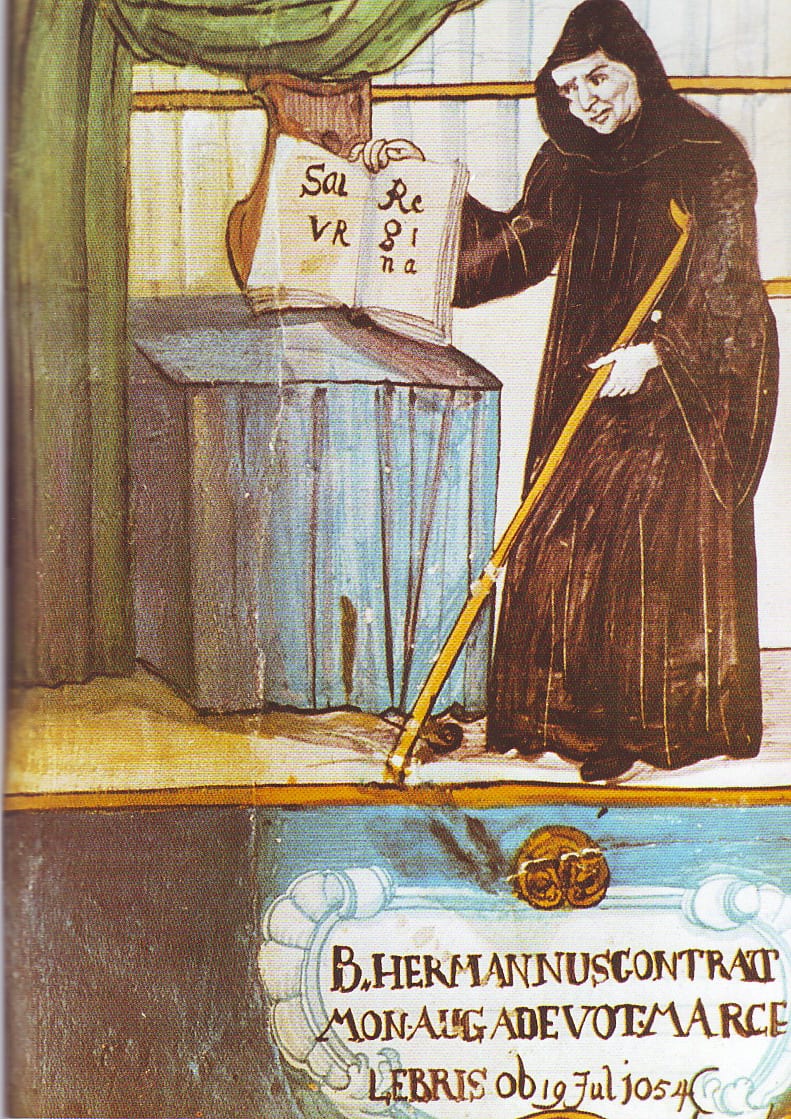
Hermann was born to Count Wolverad II with a severe congenital disability — likely a combination of cerebral palsy, spina bifida, and a cleft palate — that left him unable to walk, with hands too weak to write unaided, and a speech impediment that made him barely intelligible. His parents entrusted him at seven to the Benedictine abbey of Reichenau on Lake Constance, where he lived and worked for the rest of his life.
Despite his physical limitations he became one of the most learned men of the eleventh century. He wrote the Chronicon (a universal history from Christ to 1054), treatises on astronomy and the astrolabe, the construction of musical instruments, and Latin verse. His monastery brothers wrote down his words as he dictated them. He is the probable composer of two of the four great Marian antiphons of the Latin Church: Alma Redemptoris Mater and Salve Regina.
The Salve Regina — sung daily at Compline through the long second half of the liturgical year — became, through his hand, one of the most universally beloved prayers of Western Christianity. The Cistercians, Dominicans, and Carthusians all made it the closing prayer of the day. He died at Reichenau at forty-one, and was beatified by Pope Pius IX in 1863.