
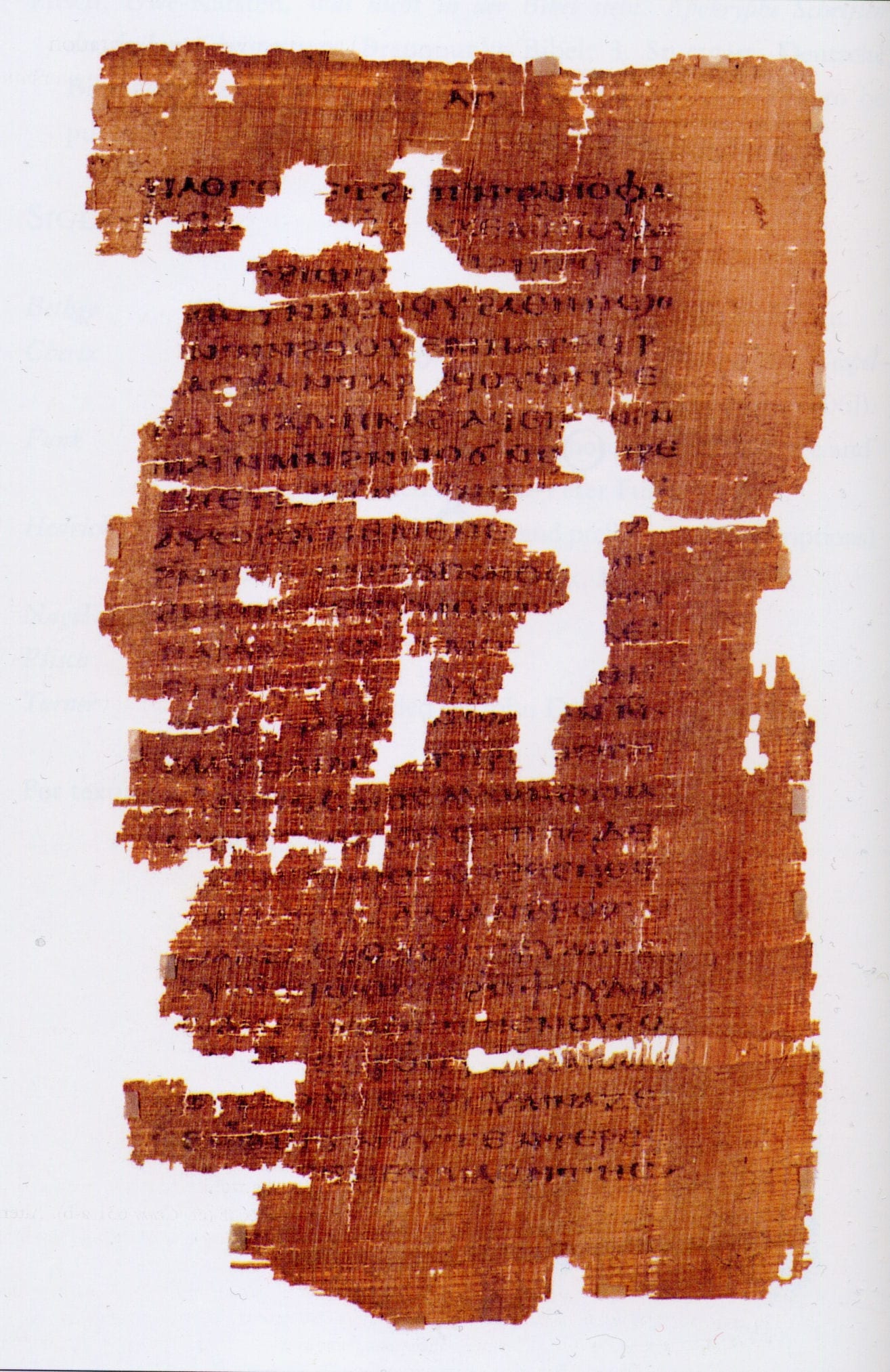
Hermas (Greek Hermas, possibly a freedman's Greek name) is named by Paul in Romans 16:14 in the list of Roman Christians to whom he sends greetings ('Salute Asyncritus, Phlegon, Hermes, Patrobas, Hermas, and the brethren that are with them'). The early Church tradition (preserved by Origen of Alexandria and Eusebius of Caesarea) identifies this Hermas with the author of the 2nd-century Catholic visionary-catechetical work The Shepherd of Hermas — one of the most widely-read Christian texts of the 2nd and 3rd centuries, included in several early biblical canonical lists (most notably the Codex Sinaiticus, the 4th-century Greek Bible, which includes it after the Apocalypse).
Modern critical scholarship has complicated this identification. The actual composition of The Shepherd of Hermas almost certainly belongs to the first half of the 2nd century (c. AD 100–155), making the author chronologically later than the Hermas greeted in Romans 16. The Muratorian Fragment (c. AD 170) explicitly identifies the Shepherd's author as a brother of Pius I, the Bishop of Rome from c. AD 140–155.
The traditional Latin and Byzantine cults — both of which celebrate Hermas as one of the Seventy and as a contemporary of Paul — are most economically explained as conflating two different Hermas figures: the New Testament Pauline collaborator of the 50s and the 2nd-century visionary author. Both are venerated as saints in the Christian tradition. The Shepherd of Hermas itself, with its long extended series of vision narratives, parables, and angelic-shepherd dialogues, was substantially influential on the development of early Catholic teaching on post-baptismal repentance.