
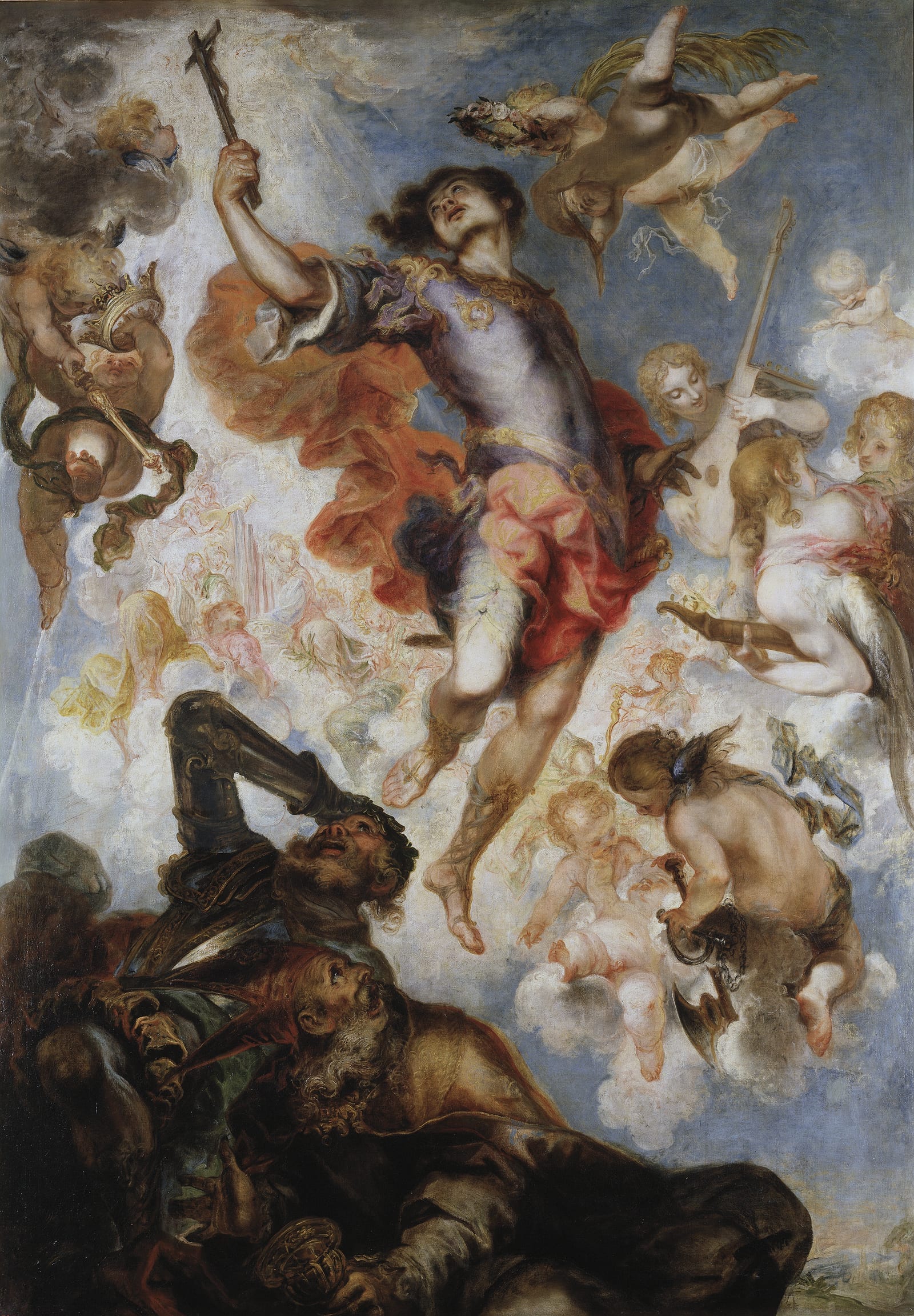
Hermenegild (Visigothic Ermengild; Latin Hermenegildus) was the elder son of the Visigothic King Liuvigild of Hispania (reigned 568–586) — the principal Visigothic king of the late 6th century, an Arian Christian who governed the Iberian peninsula from the Visigothic capital at Toledo. Hermenegild was raised an Arian Christian like his father.
Around 579 AD, when Hermenegild was about fifteen years old, he was married — for political reasons — to the Frankish Catholic Princess Ingund (the daughter of the Frankish King Sigibert I of Austrasia and Queen Brunhild). The Catholic Ingund — through the influence of her great-uncle St. Leander of Seville (see Leander's entry in the 7th-c. supplemental catalogue when we do the 7th-c. supplement) and through her own personal influence on her young Visigothic husband — converted Hermenegild to Chalcedonian-Catholic Christianity around 580 AD.
Hermenegild's father Liuvigild — recognizing the political-religious implications of his son's Catholic conversion (which would, if continued and extended, almost certainly produce a Catholic Visigothic Hispania within a generation) — initially attempted argument and pressure, then military force. Hermenegild, established by his father as governor of southern Hispania at Seville, organized substantial Catholic Visigothic noble support and held out against his father for nearly four years (581–584).
Liuvigild's military forces eventually defeated Hermenegild at Seville in 584 and arrested him. He was imprisoned and pressed repeatedly to renounce his Catholic conversion and return to Arianism. On April 13, 586 AD — Easter Sunday — Hermenegild publicly refused to receive the Easter Communion from an Arian bishop and was immediately executed at Tarragona.
The martyrdom was the foundational moment of Visigothic Catholic conversion. His younger brother Reccared — who succeeded Liuvigild on the Visigothic throne in 586 — converted to Chalcedonian-Catholic Christianity in 587 (substantially under the influence of his brother's martyrdom) and made it the official religion of the Visigothic Kingdom at the foundational Third Council of Toledo of May 8, 589 — which is the foundational moment of Spanish Catholic-Christian national identity. Hermenegild is the foundational martyr of Spanish Catholic-Christian conversion from Arianism.