
MIRACULOUS MIRACLES™

Saint — Hildegard of Bingen

St. Hildegard of Bingen
AD 1098, Bermersheim vor der Höhe — September 17, 1179, Rupertsberg
Sibyl of the Rhine — Doctor of the Church
Pfarrkirche St. Hildegard, Eibingen, Germany
Feast
September 17
Canonized
May 10, 2012 (by Benedict XVI, equipollent canonization); Doctor 2012
Doctor of the Church
Yes
Life

Hildegard was the tenth child of a noble Rhineland family. From the age of three she experienced what she called the visio — visions of light, of figures, of cosmic patterns — that she kept secret for forty years. Offered as a tithe to God, she was placed at eight in the care of the anchoress Jutta of Sponheim at the Benedictine monastery of Disibodenberg, and there she remained, taking the habit, until Jutta's death made her superior of the community in 1136.

In 1141, at forty-two, she received an interior command: 'Speak and write what you see and hear.' For three years she resisted; then, in obedience and after consultation with St. Bernard of Clairvaux and Pope Eugene III, she began. Her Scivias ('Know the Ways of the Lord,' 1141–51) was the first of three great visionary works, each painstakingly illustrated under her direction. Her authority was such that Frederick Barbarossa and the kings of England, France, and Greece wrote to her for counsel.

She composed seventy-seven liturgical songs (the Symphonia armonie celestium revelationum) — among the largest surviving bodies of music by any medieval composer — and a morality play (Ordo virtutum). She wrote treatises on medicine (Physica) and natural science (Causae et curae), made the first European description of the female orgasm in writing, and was the first woman to preach publicly to mixed audiences of clergy and laity. She died at eighty-one and was declared a saint and a Doctor of the Church by Benedict XVI in 2012 — the first medieval Marian visionary so recognised and the fourth woman Doctor.

Miracles & Phenomena
  • The Vision of 1141

    1141

    'And it came to pass... that the heavens were opened and a blinding light of exceptional brilliance flowed through my entire brain. And so it kindled my whole heart and breast like a flame... and suddenly I understood the meaning of the Psalms, the Gospels, and the other catholic books of the Old and the New Testaments.' From this vision she began to write.

  • The Symphonia

    Her seventy-seven liturgical chants and Ordo virtutum constitute the largest body of musical composition securely attributed to any 12th-century composer. They are still recorded and performed — and have entered the standard repertoire of medieval music.

  • Public Preaching Tours (1158–1170)

    In her sixties she undertook four long preaching tours across the Rhineland, addressing crowds of clergy, monks, and laypeople in cathedrals at Cologne, Trier, Liège, Mainz, and Bamberg — a unique permission for a woman of her age.

Relics
  • Body
    Relics of St. Hildegard
    St. Hildegard's Parish Church, Eibingen, Germany

    Her original tomb at Rupertsberg was destroyed in the Thirty Years' War. The relics were saved and translated to the nearby parish church of Eibingen, where they remain in a precious gold reliquary.

Iconography
  • Hildegard with the Visionary Tongue of Fire

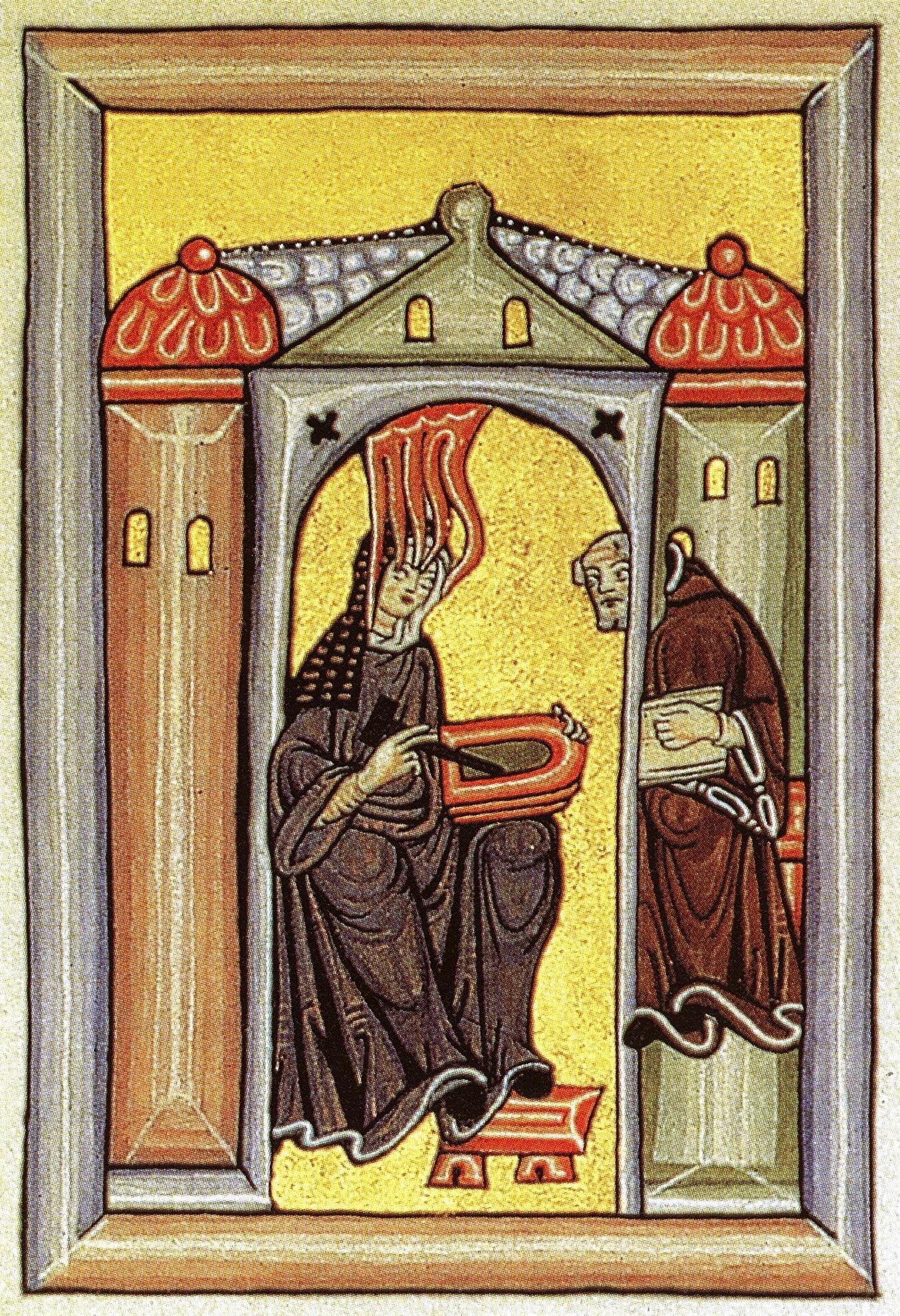
    The illuminations of her Scivias — most famously her self-portrait at the start of the Rupertsberg manuscript — show her seated at a writing desk under tongues of divine fire descending from heaven, with her secretary Volmar beside her.

Patronages
Musicians and composersEsperantistsVisionariesDiocese of Limburg
Sources & Further Reading