
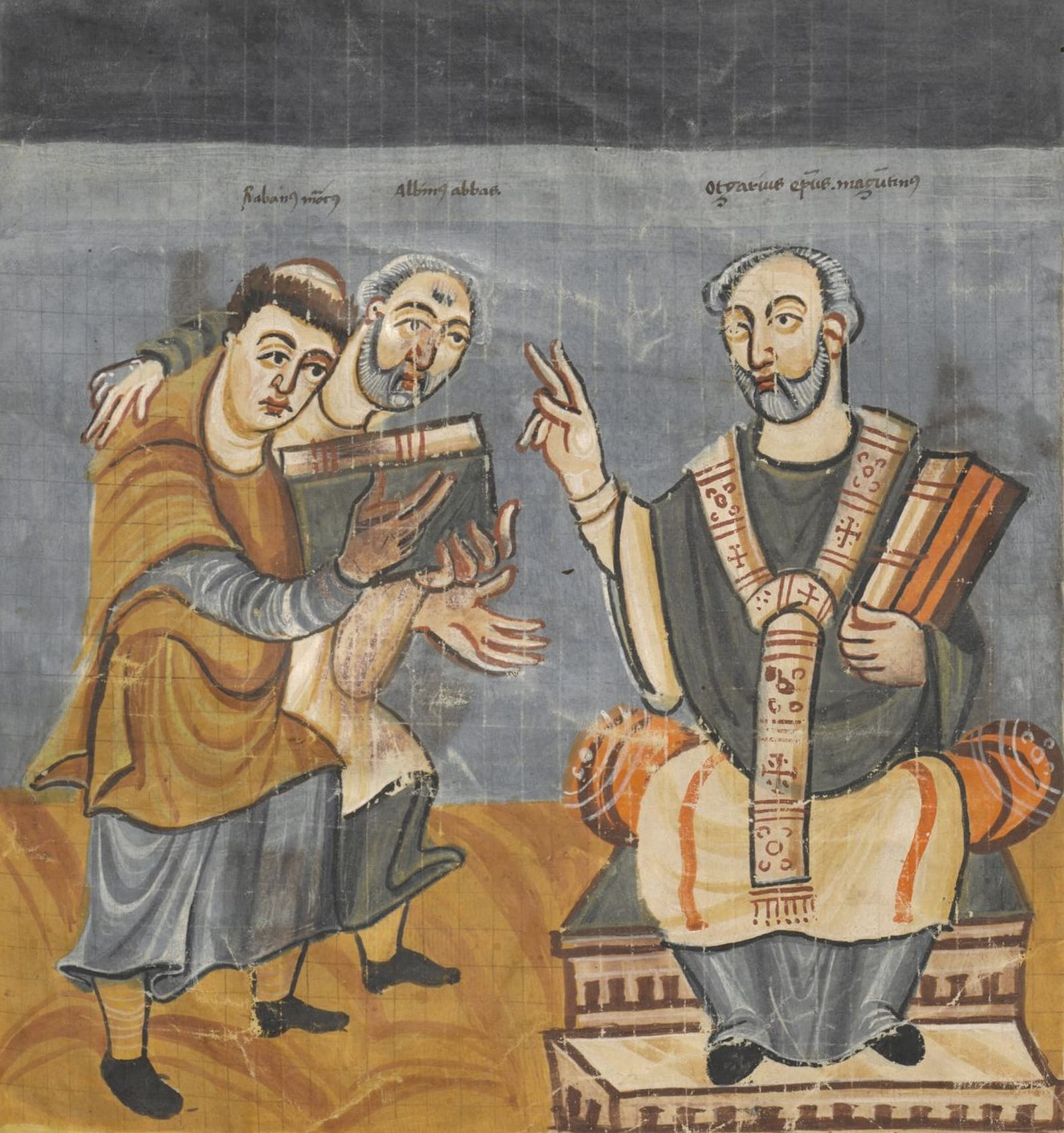
Hrabanus was given as a boy oblate to the monastery of Fulda — the great German foundation of Boniface — and sent to Tours to study under Alcuin around 802. Alcuin called him Maurus after the disciple of St. Benedict. Returning to Fulda, he taught its school until elected abbot in 822 and developed it into the principal intellectual center of the German lands.
He composed encyclopedias (the De Universo, 22 books), biblical commentaries on nearly every book of Scripture, a manual on clerical education (De Institutione Clericorum), and the magnificent De Laudibus Sanctae Crucis — twenty-eight figured poems each formed as a visual pattern (the Cross, the Lamb, the seraphim) hidden in the words on the page, the most extraordinary medieval Latin poetic-visual achievement before the Renaissance.
Resigning Fulda in 842 for a hermit's life, he was nevertheless elected archbishop of Mainz in 847 and ruled the German Church for nine more years. He died at Winkel in 856. He is honored as a saint in Germany and a Blessed by the universal Church; the modern Pope Benedict XVI named him in his catecheses on the great Doctors of the Church as 'a luminous Father.'