
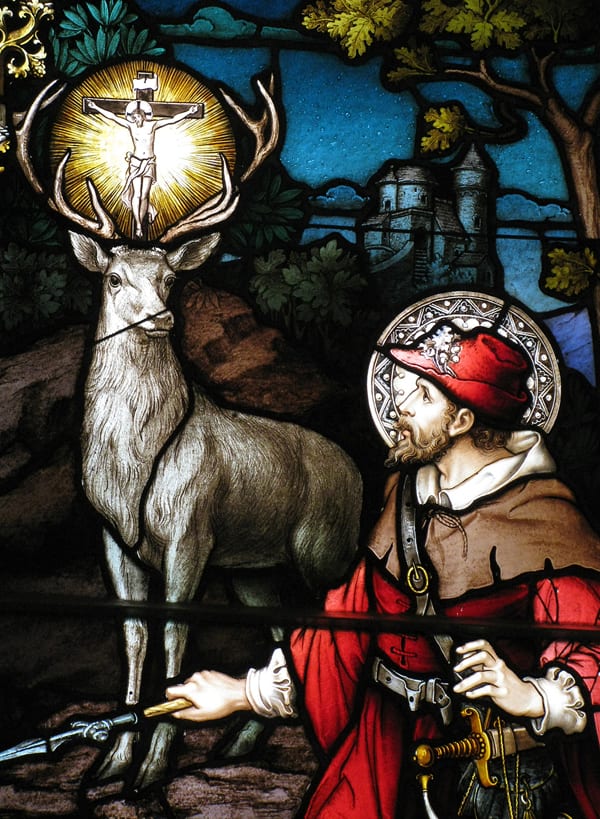
Hubert was the eldest son of Bertrand, Duke of Aquitaine, a young nobleman with a passion for the hunt. After the death of his wife in childbirth, he abandoned the court and gave himself entirely to hunting in the Ardennes forest.
On Good Friday morning around 683 — when the rest of Christendom was at the cross — Hubert was pursuing a great stag through the woods. The animal turned, and Hubert saw between its antlers a crucifix shining with heavenly light, and heard a voice: 'Hubert, unless thou turn to the Lord and lead a holy life, thou shalt quickly fall into the abyss of hell.' He fell from his horse in repentance.
He was taken under the spiritual direction of St. Lambert of Maastricht. After Lambert's martyrdom in 705, Hubert succeeded him as bishop, and shortly thereafter translated the see and the relics of Lambert from Maastricht to Liège — founding the city's ecclesiastical importance. He governed the diocese for over twenty years, evangelizing the remaining pagan villages of the Ardennes. His tomb at Saint-Hubert in the Ardennes became one of the great pilgrim shrines of the Low Countries; pilgrims with rabies brought the dogs that had bitten them to be touched with St. Hubert's stole — a tradition that gave him his patronage of animals and rabies.