
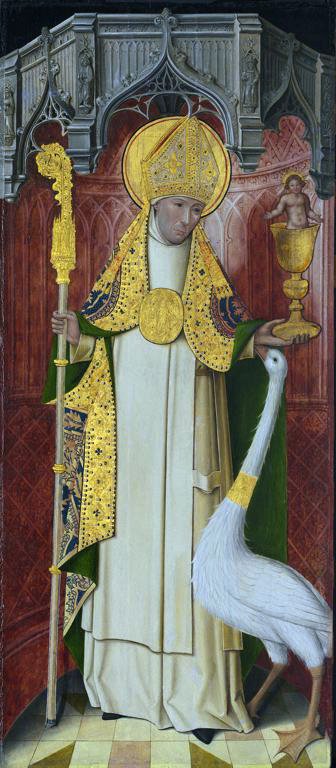
Hugh of Avalon was born in the castle of Avalon in the Dauphiné (modern French Alps), educated by Augustinian canons after the death of his mother, but at twenty-five entered the Grande Chartreuse — the original Carthusian house founded by Bruno a century earlier. He was procurator of the Chartreuse for over a decade until, in 1179, King Henry II of England (in penance for the murder of Becket nine years earlier) requested a Carthusian prior for the new Charterhouse he was founding at Witham in Somerset. Hugh was sent.
His success at Witham was such that in 1186 Henry insisted on his appointment as Bishop of Lincoln — the largest English diocese, vacant for sixteen years. Hugh accepted on the condition that he could continue Carthusian observance, returning regularly to Witham. As bishop he rebuilt Lincoln Cathedral after the earthquake of 1185 (the surviving early English Gothic east end is his work), reformed the diocesan chapter, defended the Jews of Lincoln against pogroms (he physically interposed himself before mobs three times — at Lincoln, Stamford, and Northampton), and was the one bishop willing to refuse King Richard I and King John when they demanded illegal taxes on the Church.
Throughout his episcopate he was famously accompanied by a wild swan who lived at his manor of Stow and would come to him from the lake — the swan that became his iconographic emblem. He died at his London house in November 1200; his body was carried to Lincoln by King John, the king of Scotland, three archbishops, and fourteen bishops in procession on foot. Canonized by Honorius III in 1220 — within twenty years of his death — he is one of the most beloved figures of medieval English Christianity.