
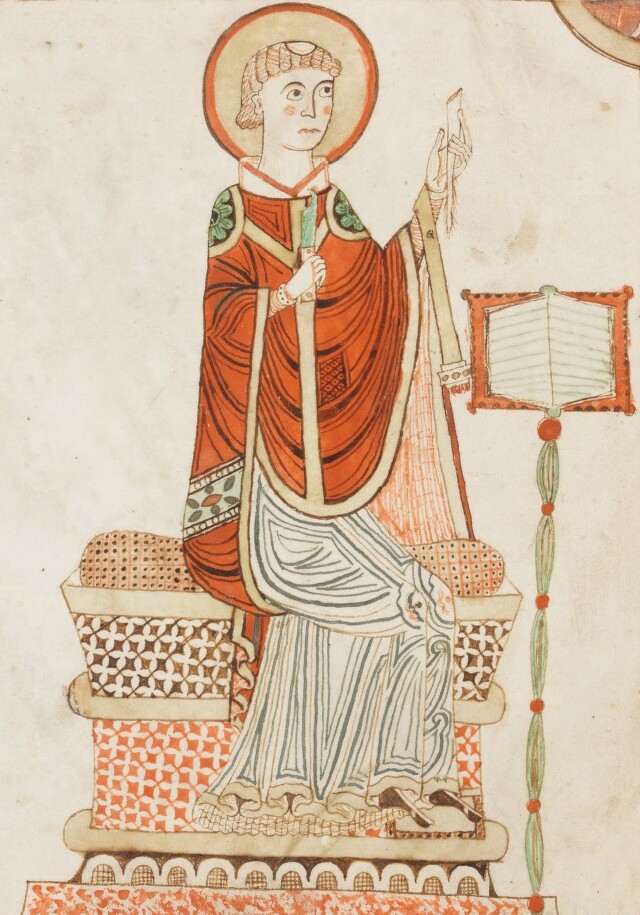
Hwætberht (Old English 'sharp/bright spear') — known by his Greek-Latin monastic nickname Eusebius — was elected sixth abbot of Wearmouth-Jarrow in 716 on the departure of Ceolfrith for Rome with the Codex Amiatinus. He had spent most of his life from infancy at Wearmouth as an oblate child, formed in the great library and scriptorium of Benedict Biscop and Ceolfrith.
He had himself travelled to Rome around 700 (during Pope Sergius I's pontificate) and brought back books and relics for Wearmouth. As abbot he was the close friend and confessor of Bede — who dedicated to him his great commentary On the Apocalypse, addressing him affectionately as 'Eusebius'.
Hwætberht governed Wearmouth-Jarrow during the golden age of its scholarship — the period when Bede completed the Ecclesiastical History, the De Temporum Ratione (the foundational medieval text on chronology and the calendar), and his complete biblical commentaries. He authored a now-lost Latin riddle-collection (Aenigmata) and grammatical works.
He survived Bede's death (May 26, 735) and died around 745 — the end of the Wearmouth-Jarrow golden age that the Viking sack of 794 would terminate.