
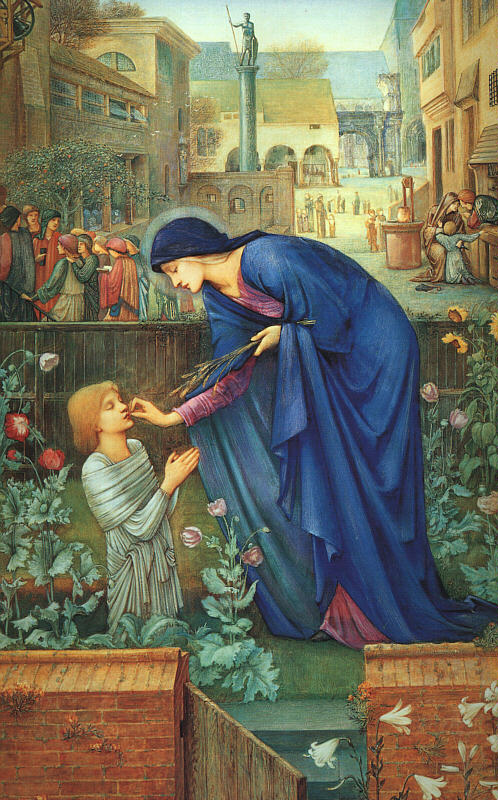
Iduberga (Latin Iduberga, French Itta) was — per the early-medieval sources — born around 592 AD to the substantial Aquitanian noble family. She married Pippin I of Landen (the Pippinid Frankish noble who was the substantial Mayor of the Palace of King Dagobert I of Austrasia) around 610 AD. The Iduberga-Pippin I marriage was the moment of the Pippinid Carolingian dynasty — the substantial Belgic-Frankish noble family that would eventually produce, through Iduberga's great-grandson Charles Martel and her great-great-grandson Pippin III, the Carolingian dynasty that would dominate medieval Western Europe.
The Iduberga-Pippin marriage produced three substantial Catholic-saintly children: St. Gertrude of Nivelles (see Gertrude's entry already in the catalogue, the abbess of Nivelles, died 659); St. Begga (the great-great-grandmother of Charlemagne and the mother of the Carolingian dynasty's substantial main line, died 693, also canonized); and Grimoald (the substantial Pippinid Mayor of the Palace who attempted in 656 to seize the Frankish throne for his son Childebert the Adopted — the substantially controversial Grimoald Coup that was the episode of the eventual Pippinid-Carolingian seizure of the Frankish throne).
After Pippin I's death in 640 AD, Iduberga — substantially elderly — withdrew from political life and around 642 AD founded the Royal Abbey of Nivelles (in the small Brabant town that is now in Walloon Belgium just south of Brussels). She installed her young daughter Gertrude as abbess; Iduberga herself served as the founding-sponsor of the new monastic foundation and lived at Nivelles as a senior religious until her death on May 8, 652 AD.
Iduberga is the matriarch of the Pippinid Catholic dynasty and the continuous Belgic-Wallonian Catholic figure. The Royal Abbey of Nivelles continued in substantial Catholic monastic operation through the medieval period; the great medieval Collégiale Sainte-Gertrude at Nivelles (substantially destroyed in the German bombing of May 14, 1940, and substantially restored after World War II) preserves the continuous cult of Iduberga, Gertrude, and Begga.