
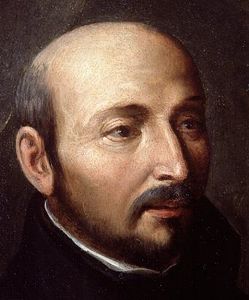
Iñigo López de Loyola was born to a noble Basque family at Loyola Castle in Azpeitia, the youngest of thirteen children. He served as a page in the court of the Catholic Monarchs' treasurer at Arévalo, then as a soldier in the Castilian army. On May 20, 1521, defending the citadel of Pamplona against a French invasion, he was struck by a cannonball that shattered his right leg. The long convalescence at Loyola Castle — with only two books in the household, the Vita Christi of Ludolph of Saxony and Jacobus de Voragine's Golden Legend of the saints — became the matrix of his conversion.
Recovering, he made the long pilgrimage to the Marian shrine of Montserrat in March 1522, exchanged his nobleman's clothes for a sackcloth, hung his sword before the Black Madonna, and spent ten months as a hermit in a cave at nearby Manresa. There, in 1522–23, he experienced the great mystical illuminations and composed the first drafts of the Spiritual Exercises — the systematic four-week retreat program of meditative prayer, examination of conscience, election of state of life, and contemplation that would shape four centuries of Catholic spirituality.
He studied theology at Alcalá, Salamanca, and finally Paris (1528–35), where he gathered six companions including Francis Xavier and Peter Faber. The seven made the foundational vows of the future Society at Montmartre on August 15, 1534 (with three later additions making ten). After the planned Holy Land mission was blocked by political circumstances, they offered themselves to Pope Paul III, who confirmed the Society of Jesus in the bull Regimini Militantis Ecclesiae on September 27, 1540. Ignatius was elected first Superior General in April 1541 and held the office until his death.
He governed the Society for fifteen years, by which time it had grown from ten to about a thousand Jesuits across thirteen provinces from Brazil to Japan. He wrote the Constitutions of the Society (1547–50) and the autobiographical Acts (the so-called 'Reminiscences') dictated 1553–55. He died at the Roman house of the Society on the morning of July 31, 1556. Canonized 1622, declared the patron of all spiritual retreats by Pius XI in 1922 on the third centenary of his canonization.