
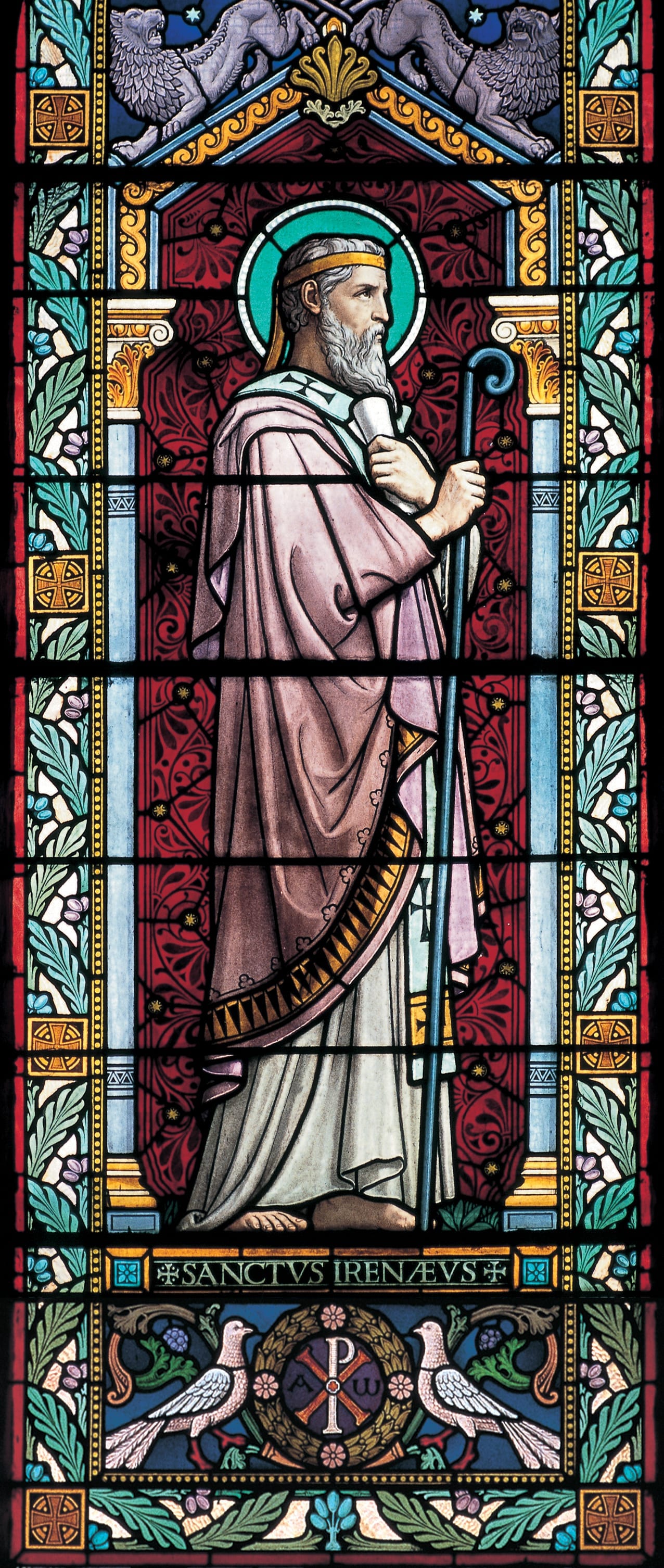
Irenaeus was born at Smyrna in Asia Minor, where as a boy he sat at the feet of St. Polycarp — the disciple of the Apostle John. Through him Irenaeus became, in his own words, a hearer of those 'who had seen the Lord.' This unbroken chain from the apostles to the second century made him the great early theologian of Tradition.
He served as a presbyter at Lyon under its first bishop, Pothinus, and was sent to Rome in 177 to mediate the Quartodeciman dispute. While he was away, the great persecution at Lyon martyred Pothinus and many others; Irenaeus returned to find his church in ruins and was made bishop.
His vast Against Heresies (Adversus Haereses) — a five-book refutation of Gnosticism — was the first systematic Catholic theology. He articulated the principle of apostolic succession, the rule of faith (regula fidei), and the necessity of communion with the Church of Rome ('the principal church') for any local church to remain orthodox. He is venerated as a martyr by ancient tradition. On January 21, 2022, Pope Francis declared him a Doctor of the Universal Church — 'the Doctor of Unity' — the first Doctor declared since 2015.