
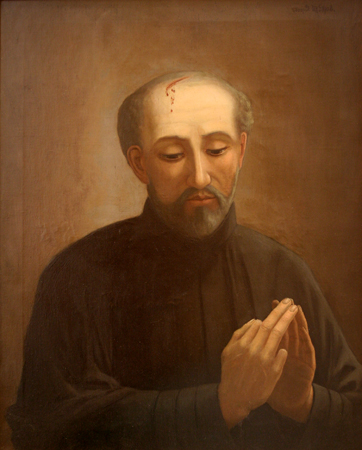
Isaac Jogues entered the Society of Jesus at seventeen and, after his ordination in 1636, sailed for New France to evangelize the Huron and Algonquin peoples along the Great Lakes and St. Lawrence. For six years he travelled the rivers and forests of what is now upstate New York, Ontario, and Quebec, learning the languages, baptizing the dying, and building chapels of bark.
In August 1642, returning from Quebec with supplies and a party of Huron converts, his canoe was ambushed by a Mohawk war party near Lake St. Peter. He was beaten, his fingernails torn out, the index fingers of both hands chewed and severed — mutilations that under canon law would later have prevented him from celebrating Mass without papal dispensation. He was kept as a slave at Ossernenon for thirteen months, baptizing dying Mohawk children in secret.
Rescued by Dutch traders at Fort Orange (Albany) in 1643, he returned to France a celebrity — Queen Anne of Austria kissed his maimed hands. Pope Urban VIII granted him a unique dispensation: 'It would be unjust that a martyr of Christ should not drink the blood of Christ.' He could have stayed in safety. Instead he asked to return to the Mohawks.
In October 1646, on a peace mission to the very village where he had been a slave, he was struck down with a tomahawk by a man of the Bear clan who blamed him for crop failures and disease. His head was set on a palisade pole; his body thrown into the Mohawk River. He was forty-one. He is canonized with seven companions: René Goupil and John de Lalande (also killed at Ossernenon); Jean de Brébeuf, Gabriel Lalemant, Anthony Daniel, Charles Garnier, and Noel Chabanel (martyred in Huronia, 1648–49).