
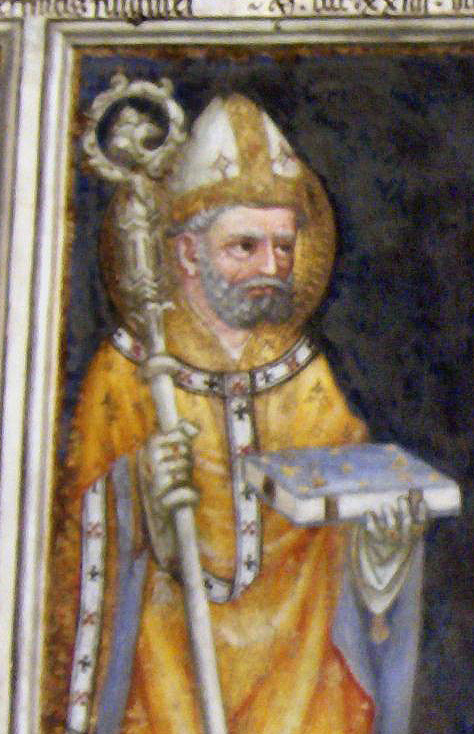
Jacobus de Voragine (Italian Jacopo da Varazze, English James of Voragine) was born around 1230 at Varazze (medieval Varagine) in Liguria, west of Genoa. He entered the Dominican Order around 1244 at the age of 14 and undertook the Dominican theological studies.
He served as Dominican Provincial of Lombardy (northern Italian Dominican Province) three times (1267–1277, 1281–1286, 1292) — the governance of one of the principal Dominican Provinces of the medieval Order. During his provincial tenure he composed his principal literary works.
In 1292, Pope Nicholas IV appointed James as Archbishop of Genoa. His six-year archiepiscopate at Genoa (1292–1298) was devoted to the pastoral reform of the Genoese diocese, the reconciliation of the Guelph and Ghibelline factions in the Republic of Genoa, and the continued composition of his literary works.
James is most famous in the history of Catholic hagiography as the author of the Legenda Aurea (Golden Legend) — the massive Latin hagiographical compilation composed at Genoa around 1260–1275 and revised and expanded until his death in 1298.
The Golden Legend is the single most-copied and most-read Latin book of the entire medieval period after the Bible — with over 1,000 surviving medieval manuscripts (more than any other medieval Latin text apart from the Vulgate), innumerable printed editions from the invention of printing in 1454 through the 16th century, and translations into every European vernacular (English, French, German, Italian, Spanish, Dutch, Czech, Polish, etc.) during the late-medieval and early-modern periods.
The Golden Legend arranges hagiographical narratives of approximately 180 saints according to the liturgical calendar — including treatments of the principal Catholic feasts (Christmas, Epiphany, Easter, Pentecost, etc.) and biographical narratives of virtually all the principal medieval Catholic saints. The text is distinguished by the rich narrative color, the vivid miracle-narratives, and the specifically Dominican theological-pastoral perspective.
The Golden Legend provided the principal source-material for the entire late-medieval Catholic hagiographical iconography — underpinning the Simone Martini, Duccio, Giotto, Fra Angelico, Raphael, and virtually every late-medieval and early-Renaissance Italian religious painter's hagiographical iconographic vocabulary.
James also composed multiple additional works: the Chronica Civitatis Ianuensis (Chronicle of the City of Genoa, 1295–1296, the principal medieval Latin history of Genoa) and a large corpus of Latin sermons.
He died at Genoa on July 13, 1298.