
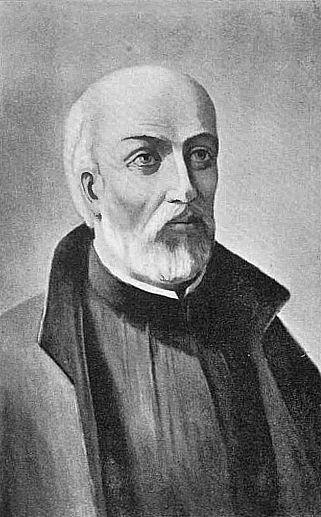
Jean de Brébeuf was born to a Norman noble family, entered the Society of Jesus at Rouen in 1617, and was ordained priest in 1622. He was among the first wave of Jesuit missionaries to New France, arriving at Québec in 1625 with Charles Lalemant and Énemond Massé. The mission was interrupted by the English capture of Quebec in 1629; Brébeuf returned to France until 1633, when New France was restored to French sovereignty and the Jesuit mission resumed.
From 1634 to 1649 Brébeuf — a powerfully-built man known to the Huron as 'Echon' for his physical resilience — lived in the great Huron mission territory north of Lake Simcoe and west of Lake Huron. He learned Wendat (the Huron language) with unprecedented thoroughness, composed the first systematic Wendat grammar and dictionary, translated the entire Catholic catechism and a long series of liturgical texts into Wendat, and composed the famous Huron Carol ('Jesous Ahatonhia' — the first Christmas hymn in any North American indigenous language). He converted thousands of Huron and trained the first generation of indigenous catechists.
In the spring of 1649, in the climactic Iroquois (Haudenosaunee) invasion of Huronia that effectively destroyed the Huron Confederacy, Brébeuf and his fellow Jesuit Gabriel Lalemant were captured at the mission of Saint-Ignace by Iroquois warriors on March 16, 1649. They were subjected to the long sequence of ritualized torments customary in that conflict for valued enemy combatants — being bound to stakes, having their flesh cut and burned, being given a 'collar' of red-hot iron axe-heads, being baptized in boiling water in mockery of the sacrament, and having the heart cut out at the end (according to Iroquois testimony recorded later, the warriors drank his blood in tribute to his courage). Brébeuf is said to have remained silent throughout, praying for his torturers. He died after about four hours; Lalemant survived seventeen hours of similar treatment before death. Beatified 1925, canonized 1930 with the other seven Canadian Martyrs.