
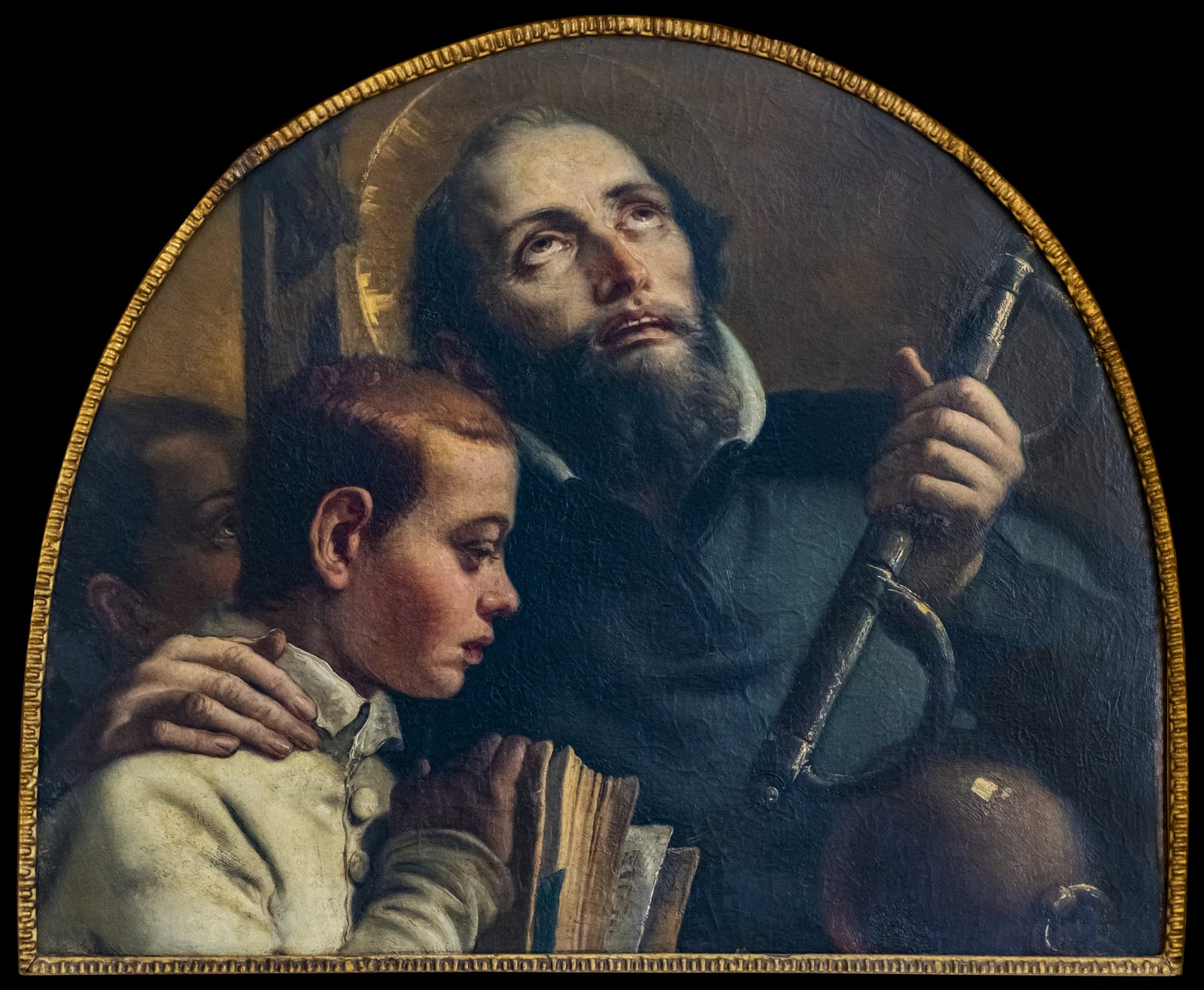
Girolamo Miani, as Venice called him, ran away to the army at fifteen and became a soldier of the Republic. In the war of the League of Cambrai he commanded the fortress of Castelnuovo above the Piave, was taken when it fell, and was chained in a dungeon. He escaped, and held to the end of his life that Our Lady had freed him; he walked to her shrine at Treviso and hung his chains before her altar, where the story was still told when the encyclopedias of the last century were written.
He was ordained in 1518 and gave the rest of his life to the poor of Venice. The famine and plague of 1528 filled the city with children who had no one, and he took them in, renting a house for them and then founding orphanages at Verona, Brescia, Bergamo and Milan. In 1532 he gathered the men who worked with him into a society with its motherhouse at Somasca, a hamlet in the hills between Bergamo and Lecco, and from the place they took their name: the Somaschi, Clerks Regular of Somasca, who still keep schools and homes for children.
He died at Somasca on 8 February 1537, of the plague he had caught nursing its victims. Benedict XIV beatified him in 1747, Clement XIII canonised him in 1767, and in 1928 Pius XI named him patron of orphans and abandoned children, which is the title the calendar remembers him by.