
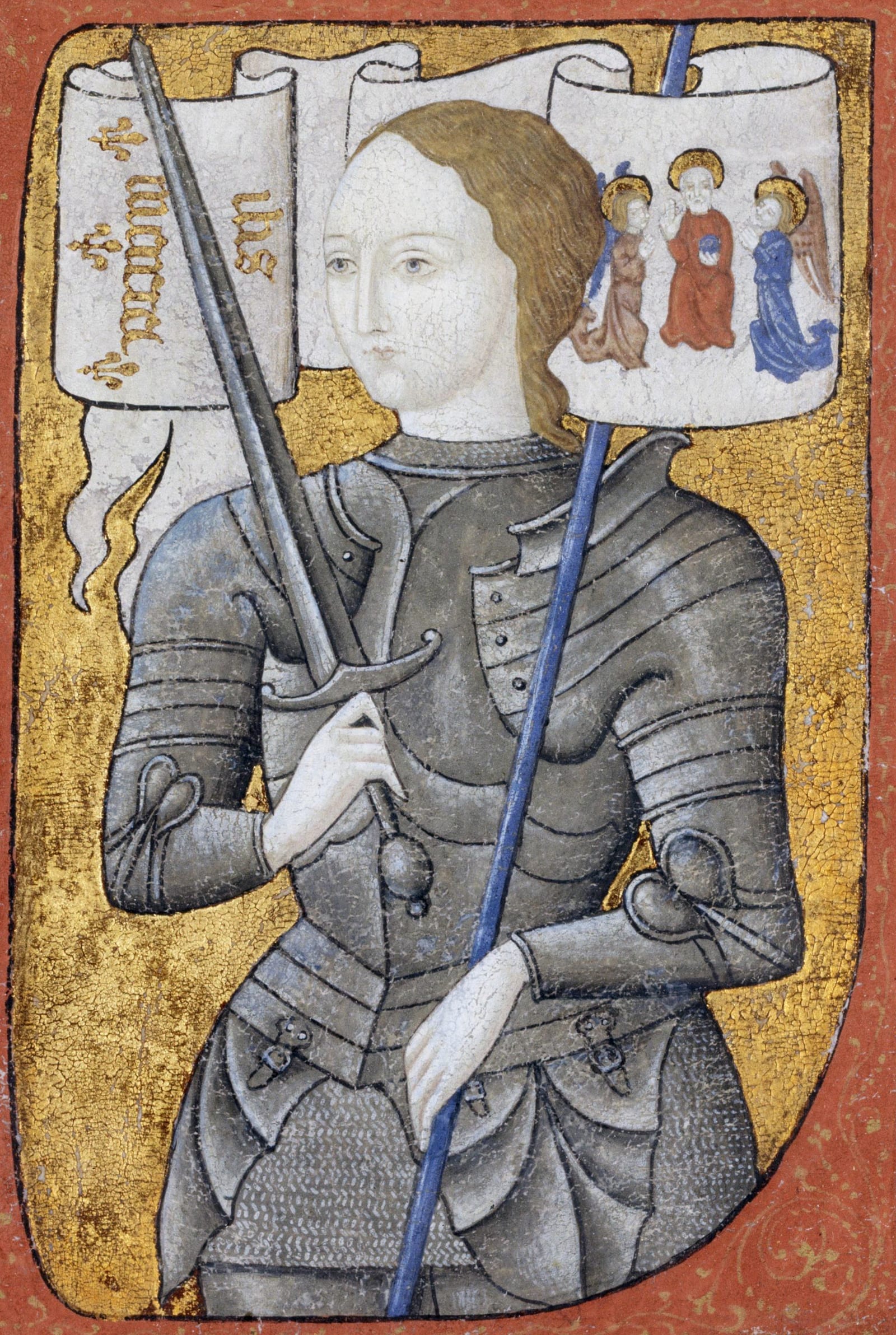
Jeanne d'Arc was born to a peasant family in the village of Domrémy on the borders of Lorraine and Champagne, in the catastrophic last decades of the Hundred Years' War. From the age of thirteen she began to hear voices — which she identified as St. Michael the Archangel, St. Catherine of Alexandria, and St. Margaret of Antioch — telling her to lead the army of the Dauphin Charles to the relief of Orléans, then under English siege, and to bring him to be crowned at Reims.
At sixteen she persuaded the captain of nearby Vaucouleurs to send her under armed escort across hostile English-held territory to the Dauphin at Chinon (February 1429). After theological examination at Poitiers she was given armour, a white banner with the names Jhesus Maria, and a small armed escort. She led the relief of Orléans (April–May 1429) with extraordinary success, took the English fortifications at Jargeau, Meung, and Beaugency in eight days (June 1429), defeated the English field army at Patay, and conducted the Dauphin to his coronation as Charles VII at Reims Cathedral on July 17, 1429 — restoring the legitimacy of the French crown in the eyes of medieval Christendom.
Captured by Burgundian forces at Compiègne on May 23, 1430 and sold to the English for 10,000 livres tournois, she was tried for heresy at Rouen by a court of pro-English French ecclesiastics under Bishop Pierre Cauchon. The trial transcripts survive intact and are among the most extraordinary documents in medieval Christianity — Joan, illiterate, intermittently shrewd and intermittently exhausted, holding her ground against trained inquisitors. Condemned for relapsed heresy on May 29, 1431, she was burned at the stake in the Old Market of Rouen the next day, repeating the name of Jesus to the end. Her ashes were thrown into the Seine. A second papal trial in 1456 annulled the original verdict and declared her innocent. Pope Benedict XV canonized her in 1920.
She is not a martyr, and the Church was careful about it. Benedict XV canonized her on 16 May 1920 by the bull Divina disponente as a VIRGIN — the title she still carries in the calendar — and not as a martyr, a mystic, or a soldier. Martyrdom requires death in odium fidei — in hatred of the faith, and Joan was condemned on political grounds by a court of churchmen in English pay; to call her a martyr would be to say the Church killed her for believing. Her own conduct was weighed too: she had recanted once under threat of the fire before withdrawing the recantation, and she tried repeatedly to escape, neither of which is how the tradition describes a martyr approaching death. What the Church did instead was annul the trial. The rehabilitation of 1456 found the 1431 proceedings procedurally corrupt and declared her innocent, twenty-five years after the fire and four hundred and fifty-three before Pius X beatified her at St Peter's on 18 April 1909.