
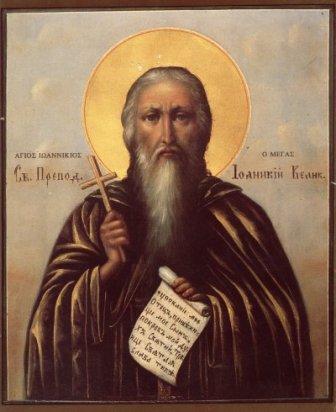
Joannicius (Greek Iōannikios) was born around 752 to a Greek-Anatolian peasant family in Marycaton, Bithynia. As a young man he served twenty-four years in the Byzantine imperial army — having been (per his Vita) initially a partisan of the iconoclast cause until his conversion under a saintly old hermit who prophesied his future iconodule monastic vocation.
Around 796, at age 44, he left the army and withdrew to the Mount Olympus in Bithynia (modern Uludağ near Bursa, Turkey) — the Byzantine monastic-hermit centre that under Joannicius's example became the 9th–11th-century Byzantine-monastic equivalent of Egyptian Wadi Natrun or 6th-century Mar Saba.
For fifty years (796–846) he lived as a hermit on Mount Olympus, founding multiple cells and monasteries — among them the principal monastery of Antidium where he died.
He was the monastic-spiritual authority of the iconodule resistance to the second iconoclast crisis (815–843) — visited and consulted by all the major iconodule confessors (Theodore the Studite, Methodius I, Theophanes the Branded). After the iconodule restoration of 843, the new Patriarch Methodius I (who had been one of his spiritual sons on Mount Olympus) sought Joannicius's personal endorsement of the new iconodule consensus.
Joannicius died on Mount Olympus on November 4, 846, at the age of 94 — the link between the iconodule confessor-generation of the second iconoclast crisis and the restored iconodule consensus that would shape the entire Byzantine-Catholic and Orthodox theological tradition.