
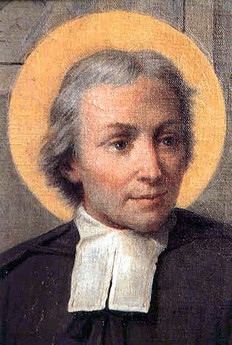
Jean-Baptiste de la Salle was born to a magistracy family at Reims, ordained priest in 1678, and held the family-inherited canonry at Reims cathedral. He encountered the question of free schooling for poor boys almost accidentally in 1679, when an acquaintance asked him for help administering a new school at Reims for the city's poor. The encounter changed his life. Over the next twenty years he gave away his entire family inheritance, distributed his canonry, and moved (with deliberate downward social mobility that scandalized his clerical Champagne) into a small lay community of male schoolteachers.
In 1684, with a dozen companions, he founded the Brothers of the Christian Schools (the Frères des Écoles Chrétiennes, popularly called the De La Salle Brothers). The Brothers were a lay religious congregation specifically dedicated to free schools for poor boys — distinguished from de la Salle's own clerical state by his deliberate decision that the Brothers should not be ordained priests, so that they would remain entirely focused on education rather than on parochial-sacramental work. His Conduite des Écoles Chrétiennes (1706) codified a new pedagogy — silent classrooms, simultaneous group instruction (rather than the medieval one-at-a-time tutorial model), a fixed curriculum, formal teacher training. The Brothers' Manuel of teacher training, established at Reims in 1684, is the first formal teachers' college in modern European history.
He died at Saint-Yon near Rouen on Good Friday, April 7, 1719. The De La Salle Brothers, suppressed and dispersed during the French Revolution, were re-established under Napoleon in 1801 and grew through the 19th and 20th centuries to become the largest Catholic teaching order in the world — by 1950 with over 17,000 Brothers on every inhabited continent. Canonized 1900. Designated by Pius XII in 1950 the universal patron of all Catholic teachers.