
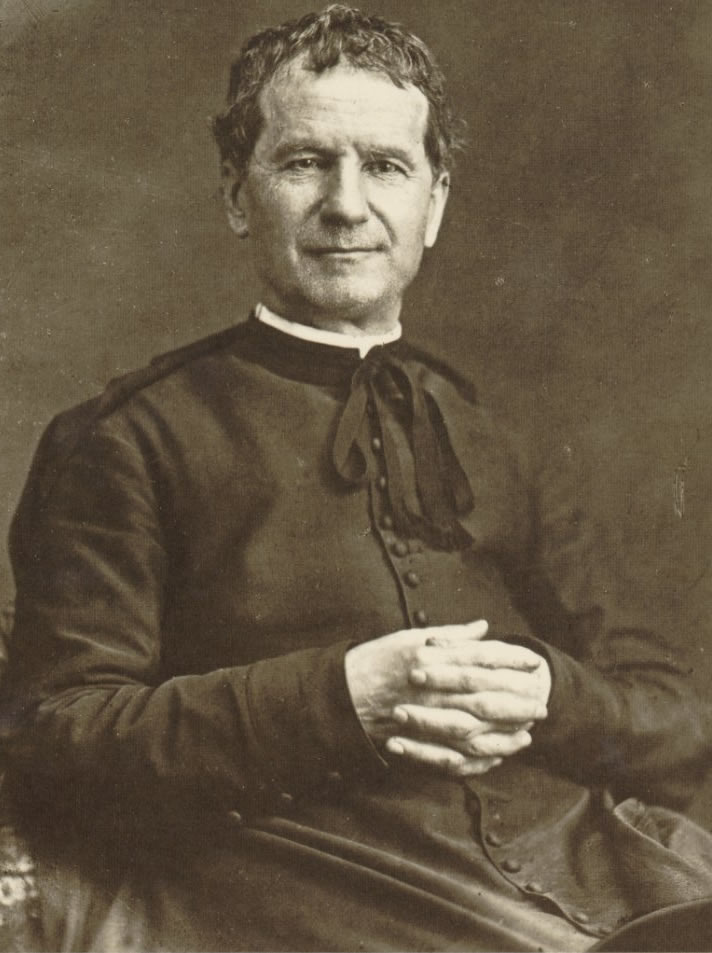
Giovanni Melchiorre Bosco was born to a peasant family in the Becchi hamlet of the small Piedmontese town of Castelnuovo d'Asti. His father died when he was two; his mother Margherita — a remarkably resourceful peasant woman who would be his lifelong collaborator — raised him through the Piedmontese famines and political convulsions of the 1820s and 1830s. At nine he had a famous prophetic dream of becoming an apostle to wild boys, who would be transformed into lambs through patience.
He was ordained priest in 1841 at twenty-six, did postgraduate study at the Turin Convitto Ecclesiastico under Joseph Cafasso (see Cafasso entry), and — through Cafasso's direct mentorship — began visiting the Turin Carceri Giovanili (juvenile prison) where he encountered the disaster of the rapidly-industrializing northern Italian capital: thousands of teenaged street boys, orphans, apprentice runaways, and former agricultural day-labourers reduced to homelessness, crime, and prostitution by the collapse of the rural economy.
On December 8, 1841 — the feast of the Immaculate Conception — Bosco encountered the first of his street boys, the fifteen-year-old Bartolomeo Garelli, at the church of San Francesco d'Assisi in Turin. The first 'Oratory' (informal Sunday school) was held the following week with eight boys, then twenty, then a hundred. By 1846 — when the Marchesa Barolo gave Bosco a small property at Valdocco on the northern outskirts of Turin — the Oratory had moved into permanent quarters; by 1850 it was a residential boys' home, evening school, and trade-apprenticeship workshop with several hundred boys. By Bosco's death the Salesian Society (Pious Society of Saint Francis de Sales — Bosco took the name of the gentle 17th-century Francis de Sales as patron, see his entry already in the catalogue) had grown to over 700 Salesians staffing nearly 60 houses on four continents.
His ministry combined three distinct dimensions: (1) the educational-pastoral method he called the 'preventive system' — based not on punishment but on reason, religion, and lovingness (ragione, religione, amorevolezza), built around continuous adult Catholic presence among the boys, daily Mass, frequent confession, and the development of trade skills; (2) the deep mystical-prophetic life that produced his celebrated dreams, repeated bilocations attested by multiple independent witnesses, and a prophetic gift in personal direction; (3) the institutional Salesian congregations: the Salesians (1859) for men, the Daughters of Mary Help of Christians (1872, co-founded with Mary Mazzarello) for women, and the Salesian Cooperators (1875) for lay collaboration. He died at the Oratory of Valdocco on January 31, 1888 at seventy-two. Canonized 1934.