
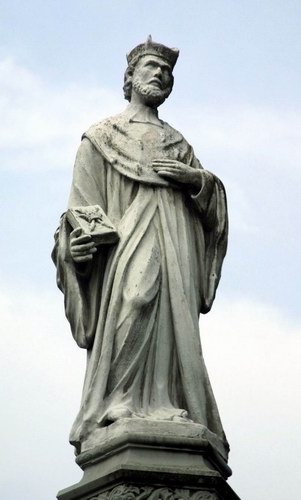
Jan of Kęty was born to a pious peasant-yeoman family in the small Lesser Polish town of Kęty (Cantia in Latin — hence his name). He travelled to Kraków to study at the Cracow Academy (the recently-refounded Jagiellonian University), took his doctorate in theology in 1418, and spent the remainder of his life as a professor of theology and Scripture at the university — over fifty years of teaching the same students at the same university.
He is the personification of the type of the modest, holy university professor. He lived in a single room, ate at the students' table, gave most of his salary to the poor (he repeatedly bought new clothes for himself only to give them to beggars en route home from the tailor), made several penitential pilgrimages on foot to Rome (in his sixties) and to Jerusalem, and continued teaching scripture and theology to the end. He was the personal model invoked by the great Polish Counter-Reformation theologians (Stanislaus Hosius, Piotr Skarga) and by the Polish-Catholic university tradition through John Paul II — who taught at the same Cracow Academy almost five centuries later.
He died on Christmas Eve 1473 and was canonized by Clement XIII in 1767. He is a co-patron of Poland and Lithuania.