
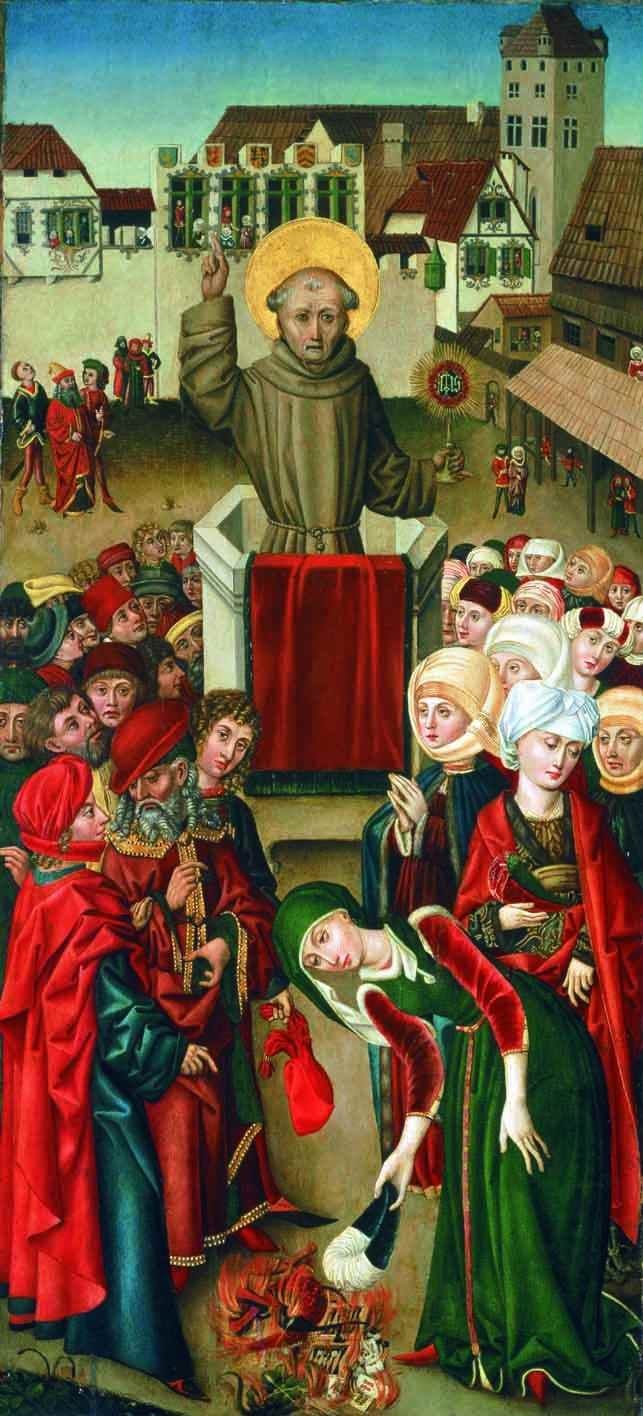
Giovanni da Capestrano was educated in law at Perugia, served as governor of the city under the Pope, was captured in a war between Perugia and the Malatesta of Rimini in 1416, and during his imprisonment underwent a conversion. On his release, having no canonical impediment to ecclesiastical life, he entered the Observant Franciscans at Perugia in 1416 and was ordained priest in 1420.
He became the central preaching partner of Bernardine of Siena across the Italian Quattrocento, sharing the wandering preaching ministry and the promotion of the IHS Holy Name devotion. He worked tirelessly against Bohemian Hussites in central Europe, founded a Franciscan reformed observance in the Holy Land, and was the principal Italian negotiator at the Council of Florence (1439) alongside Bessarion. He preached in Italian to Germans, Hungarians, Slovaks, and Poles — and (like Vincent Ferrer) was reportedly understood by all.
His final mission was the most spectacular. In 1454, at sixty-eight, he travelled to the Hungarian frontier where the Ottoman Sultan Mehmed II — fresh from the conquest of Constantinople (1453) — was preparing to march on Belgrade. With seventy-year-old Hungarian commander János Hunyadi he raised a crusader-army of mostly peasants — perhaps 30,000 — to relieve Belgrade. The siege began on July 4, 1456. On July 22, after weeks of severe combat, the besieged garrison broke out and Capistrano led a column of armed peasants directly into the Ottoman camp. The Ottoman army was routed and Mehmed himself wounded. Belgrade was saved — the only major defeat the Ottomans suffered in Europe between 1453 and 1683. Pope Callixtus III ordered the noon Angelus to be rung in every parish in Christendom in commemoration — the origin of the tradition of the noon Angelus that still continues in many Catholic countries. Capistrano died of plague at Ilok three months later. Canonized in 1690.