
MIRACULOUS MIRACLES™

Saint — John Chrysostom

St. John Chrysostom
c. AD 347 — September 14, 407
Golden-mouthed — Doctor of the Church
Patriarchal Cathedral of St. George, Constantinople (Istanbul), Turkey
Feast
September 13 (Roman); November 13 and January 27 (Byzantine)
Doctor of the Church
Yes
Life

John was born at Antioch and trained in rhetoric under the great pagan teacher Libanius — who reportedly named him his intended successor 'if only the Christians had not stolen him from us.' He withdrew to ascetic life for six years, ruining his stomach and his digestion in the process; the rest of his life he ate sparingly and alone.

Recalled to Antioch and ordained a priest in 386, he preached daily for twelve years to the great congregation of one of the largest cities of the empire. The clarity, vehemence, and beauty of his sermons earned him in his own lifetime the surname Chrysostomos — Golden-mouthed. His series on the Pauline epistles and the Gospel of Matthew are still read.

In 398, against his will, he was abducted by imperial order and consecrated Patriarch of Constantinople. He immediately reformed the imperial city's clergy and unsparingly denounced the luxury of the court — especially the empress Eudoxia. Twice deposed and exiled at her instigation, he died of exhaustion on the road to his final place of exile in 407, his last words: 'Glory be to God for all things.' His relics, taken to Rome after the Fourth Crusade, were returned to the Ecumenical Patriarchate by Pope John Paul II in 2004.

Miracles & Phenomena
  • The Liturgy of St. John Chrysostom

    The principal eucharistic liturgy of the Byzantine rite — used throughout the year in every Orthodox church and in the Eastern Catholic churches that share the Byzantine tradition — bears his name and substantially preserves his liturgical reform. It is the most-celebrated Christian liturgy on earth.

  • The Sermons

    His preaching ministry — eleven hours of preserved sermons, including the great cycles on Matthew (90 homilies), John (88), Acts (55), Romans (32), and 1 Corinthians (44) — is the largest body of preaching to survive from the early Church. He is the source of more text in the Roman breviary than any father except Augustine.

Relics
  • Body
    Relics of St. John Chrysostom
    Patriarchal Cathedral of St. George, Constantinople (Istanbul, Phanar district)

    After the Fourth Crusade his relics were taken to Rome and placed at St. Peter's. On November 27, 2004, Pope John Paul II returned them, together with those of Gregory of Nazianzus, to Ecumenical Patriarch Bartholomew. They now rest in the cathedral church of the Ecumenical Patriarchate.

  • Bodily relic
    Skull of St. John Chrysostom
    Vatopaidi Monastery, Mount Athos, Greece

    Tradition holds that this relic miraculously preserves a vivid pink hue in the ear — the ear the Apostle Paul whispered into when, according to legend, he dictated his epistles' interpretation to John during a vision.

Iconography
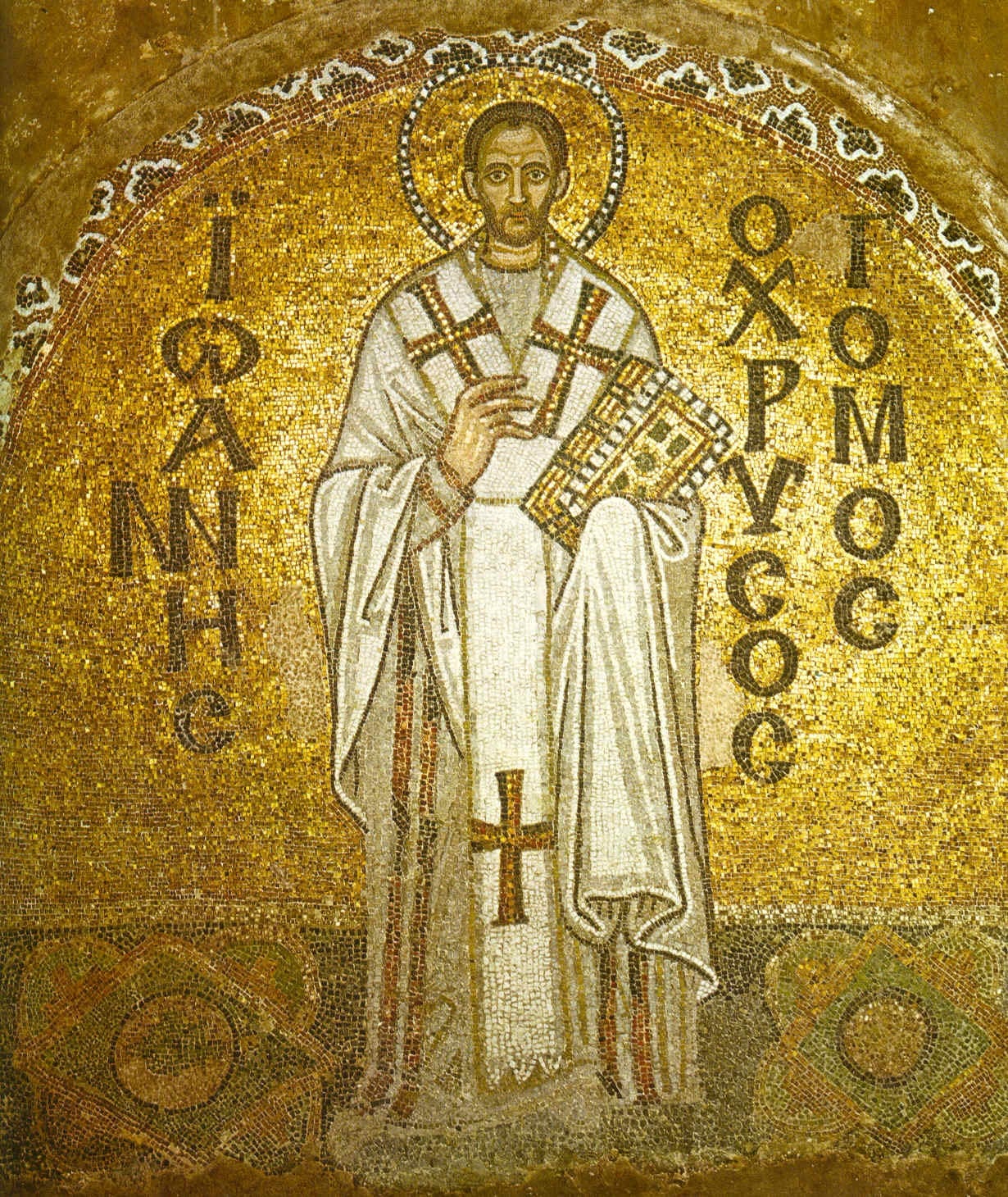
  • John Chrysostom Preaching

    Often depicted preaching from an ambo, or writing his commentaries with the Apostle Paul standing at his shoulder dictating — the iconographic source of the legend of his commentaries.

  • The Three Holy Hierarchs

    With Basil and Gregory of Nazianzus, Chrysostom forms the great Eastern triad of teachers — a feast (January 30) and icon type unique to the Byzantine tradition.

Patronages
PreachersOratorsConstantinopleLecturersEducators
Sources & Further Reading