
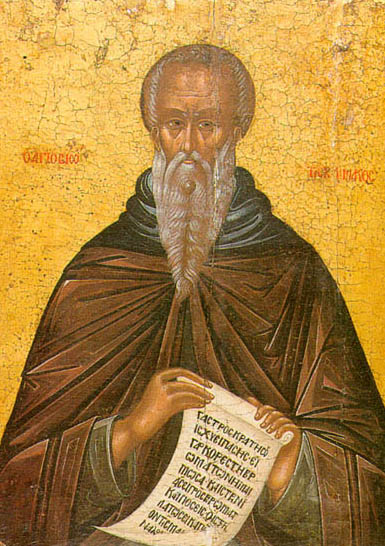
John entered the great monastery of Sinai at sixteen and lived there sixty-six years. After his master's death he withdrew to a hermitage at Tholas, eight kilometers from the monastery, for forty years of complete solitude. Around 600 he was acclaimed abbot of Sinai; in his last years he wrote his masterpiece.
The Ladder of Divine Ascent (Greek Klimax, the source of his epithet) is a 30-step manual of the monastic ascent to God — each step a chapter, like the rungs of Jacob's ladder. It treats sequentially renunciation, detachment, simplicity, obedience, repentance, mourning, gentleness, anger, slander, talkativeness, lust, avarice, despondency, gluttony, chastity, poverty, insensibility, sleep, fear, vainglory, pride, faith, hope, and love.
The Ladder has been read in every Byzantine monastery during Great Lent for more than thirteen centuries — appointed reading at the meals on every Lenten day. It is the most influential ascetic-mystical text of the Eastern Church after the New Testament itself. Translated into Latin in the 11th century, it shaped the Western contemplative tradition through Bernard, Bonaventure, and the great mystics of the Counter-Reformation.