
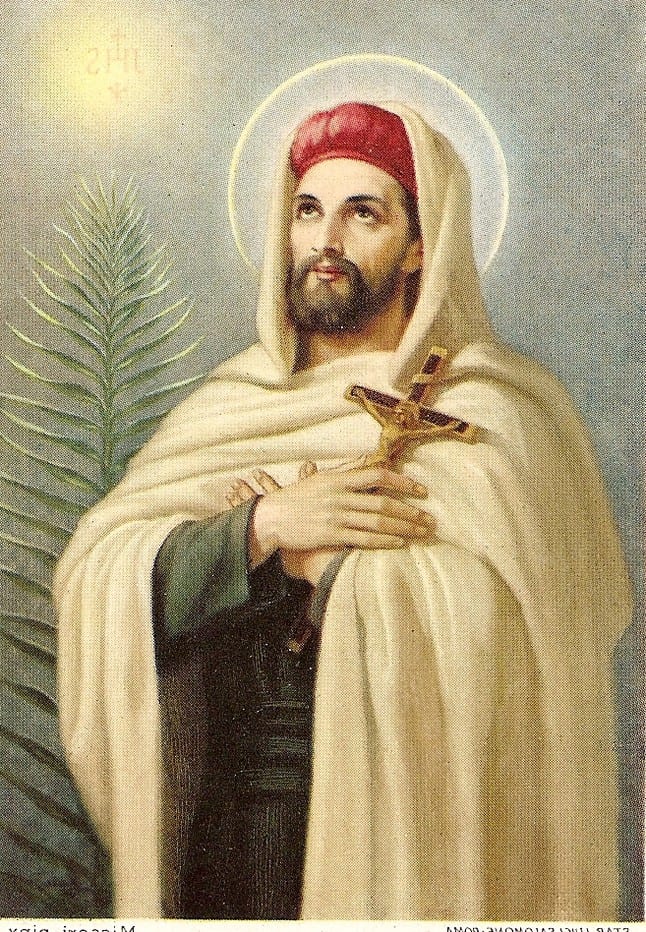
João de Brito was born to a great Portuguese noble family at Lisbon, served as page in the court of Afonso VI of Portugal, and entered the Society of Jesus in 1662 at fifteen. He volunteered for the Madurai mission of southern India, sailed in 1673, arrived at Goa and then at Madurai in 1674. He was the spiritual heir of Roberto de Nobili, who half a century earlier (1606–56) had founded the controversial Madurai 'accommodationist' Catholic mission that adapted to caste-Hindu customs and dressed Jesuits as Brahmin sannyasis.
Britto adopted de Nobili's pandaraswami habit (the saffron robe of an Indian wandering ascetic), learned Tamil to fluency and Sanskrit to working competence, and travelled the southern Tamil country on foot. He baptized an estimated 30,000 converts across twenty years across the Madurai, Tinnevelly, and Marava territories — most of them low-caste and Dalit communities. He was arrested in 1686 in Marava country, tortured (a famous physical torment involving the bending of his limbs over a wooden frame), and exiled to the Portuguese coast.
He returned to Madurai despite the danger and was arrested a second time in 1693 in Marava country, after the king of Marava's brother — a recent convert — had abandoned his polygamous marriages on Britto's instruction. The king ordered Britto's execution. He was beheaded at Oriyur on February 4, 1693 at the age of forty-five — the last and most consequential European missionary martyr of pre-modern India. The Tamil 'Britto Tradition' Christians of Madurai trace direct catechetical lineage to him today. Canonized 1947.